MiningIsHuman Story 3 - The search for copper
A Journey Through Southern Africa’s First Industrially Mined Metal

This is the first in a series exploring copper—Southern Africa’s first industrially mined metal, and today, one of the world’s most significant.
Mining’s roots run deep—woven through the tapestry of human history.
For generations, we’ve seen farming and fishing as vital threads in the story of human development. They shaped where we settled, how we traded, and how we survived. Mining belongs right there with them—not as an afterthought or late arrival, but as ancient as our urge to shape the world with our own hands.
Across southern Africa, signs of this story are everywhere—if you know how to spot them. Stones like chert, jasper, and silcrete traveled hundreds of kilometres from their origins, moved by people who understood their value. Generations returned to the same places to collect the best materials, carrying them along trade routes or passing them from hand to hand. Iron oxides, mined at scale in the Northern Cape, became pigments for adornment and ritual. Copper was smelted and traded across the Limpopo and Northern Cape. At Rooiberg, tin was mined on purpose and alloyed with copper to create bronze—a process that demanded not just knowledge of two metals, but the insight that combining them could yield something new. That’s planning, wisdom, and a legacy of practice stretching back centuries.
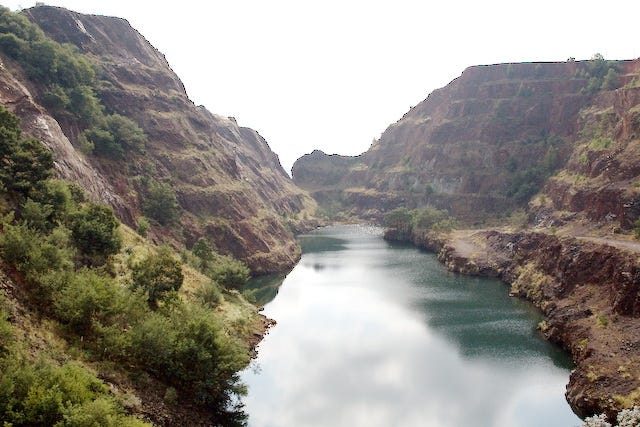
The oldest known ochre mine is Lion Cavern at Ngwenya in Eswatini. It contains evidence of intensive haematite extraction dating back 48,000 years. One ore body served a variety of technologies and cultures over millennia. By the beginning of the second millennium, miners in the Limpopo basin worked both river and reef gold, using shallow shafts, stopes, and washing circuits that demonstrate a practical understanding of continuity, water, and grade.
Mining in southern Africa did not begin with colonial capital. It did not arrive with ships, charters, or stock exchanges. What arrived with those things was a different kind of mining — industrial, export-oriented, and organised around somebody else’s balance sheet. That is an important distinction. It is where this story begins.
What Amsterdam needed
By the 1680s, the Dutch East India Company — the VOC — was the largest commercial enterprise the world had ever seen. It controlled trade routes from Amsterdam to Batavia and maintained fortified ports across three oceans. It commanded its own army and navy. On paper, it was invincible.
In its treasury, it was running short.
The VOC’s Asian trade empire ran on silver and gold. Not as commodities — as currency. To buy spices in the Banda Islands, pepper in Malabar, and silk in Nagasaki, the Company needed bullion. Enormous, continuous quantities of it. The traditional supply routes through the Middle East were disrupted. Spanish silver from the Americas flowed to rivals. The Portuguese, whom the VOC had spent decades displacing from their Asian forts, had controlled the gold trade from the African interior — and even after seizing key Portuguese positions on the West African Gold Coast, the VOC could not secure a reliable replacement supply.
Profit margins tightened. The bullion problem worsened structurally. In Amsterdam, the directors of the world’s first publicly traded company faced a balance sheet demanding a solution.
The instruction sent to the Cape was blunt: find minerals that would justify the ongoing expense of maintaining this distant post in Africa.
The man who received that instruction was Simon van der Stel, Commander of the Cape Colony. He was a company man—capable and loyal. The pressure he faced did not come from local circumstances, but from boardrooms ten thousand kilometres away. Amsterdam needed metal. The Cape needed to deliver it.
What the Nama already knew
In 1681, two years before Van der Stel assumed his post, Nama envoys arrived at the Cape carrying copper ore samples. Their accounts described copper mountains in the arid interior. The VOC recorded what the Nama described as “Koperberge (Copper Mountains)”, in the territory we now call Namaqualand.
This was not a discovery. It was the communication of knowledge that already existed, carried south along trade routes that had functioned for centuries. The Nama had been working copper for generations. They smelted it, shaped it, wore it, and traded it along networks that connected the interior to the coast, long before any European presence. The ore samples that arrived at the Cape in 1681 were not raw intelligence. They were the output of an established and sophisticated relationship between a people and their landscape.
Van der Stel listened. In 1685, he led an expedition north into Namaqualand—approximately 100 people, including soldiers, servants, and guides. It was a five-month journey into arid country, guided in large part by Nama knowledge of terrain. European maps had never recorded that land. He sank test shafts and found copper—not traces, but real deposits. The ore was high-grade and found in the hills around what is today Springbok.
Van der Stel validated Nama expertise. Yet ultimately, he left the copper behind.
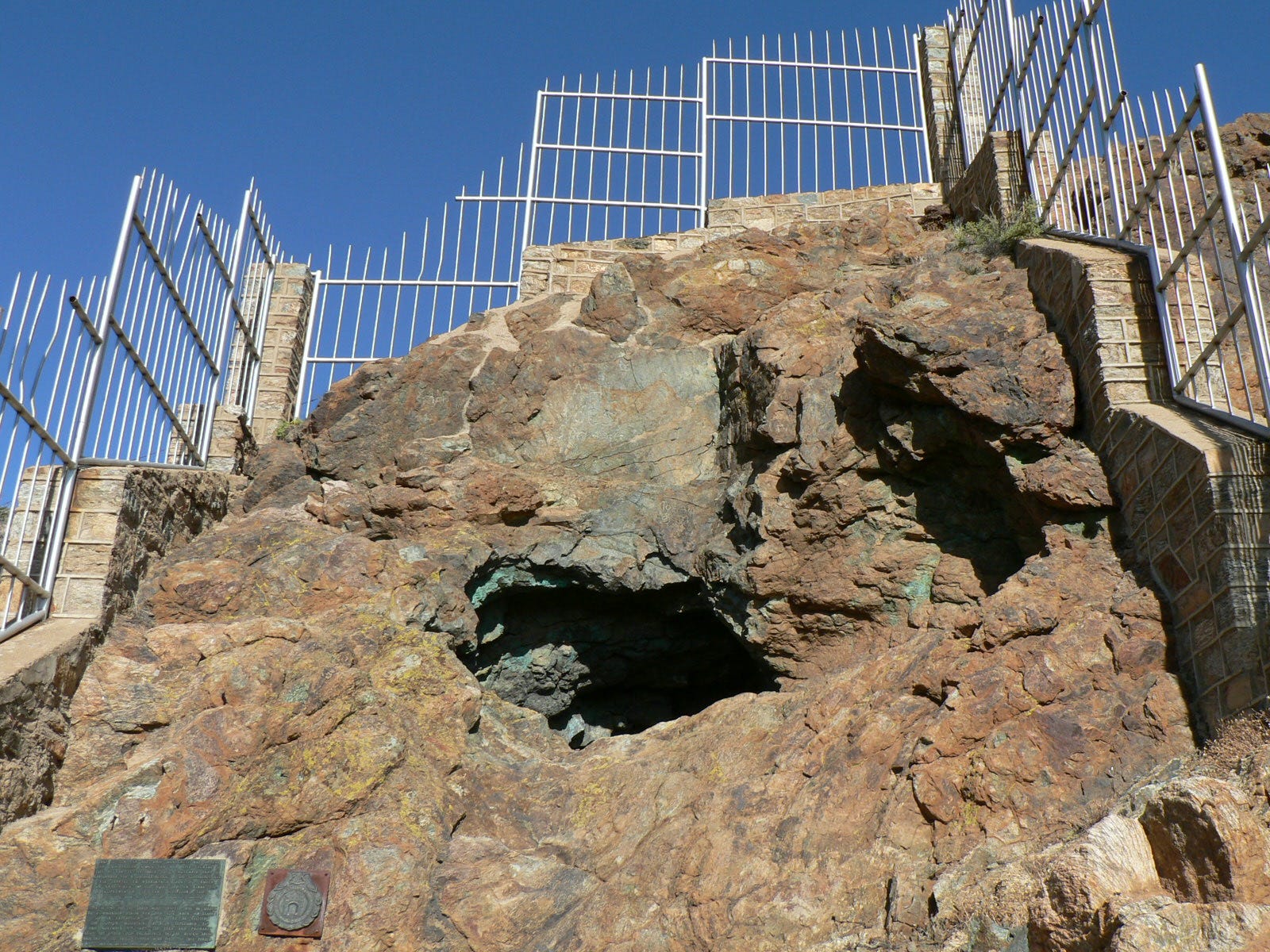
Without a harbour or roads, and without enough water to support industrial extraction, the copper had no way to move. The nearest coast was hostile and shallow. The distances were vast. The infrastructure needed did not exist. The capital to build it could not be justified for a remote colonial outpost already straining a crisis balance sheet.
Van der Stel understood the geology. He was right about the copper. Being right wasn’t enough.
What the copper waited for
The knowledge of what lay in the Namaqualand hills didn’t disappear when the expedition turned south. The Nama had always held it. Van der Stel had confirmed it. Colonial records carried it forward. What was missing was not knowledge. What was missing was the infrastructure to turn ore into an export.
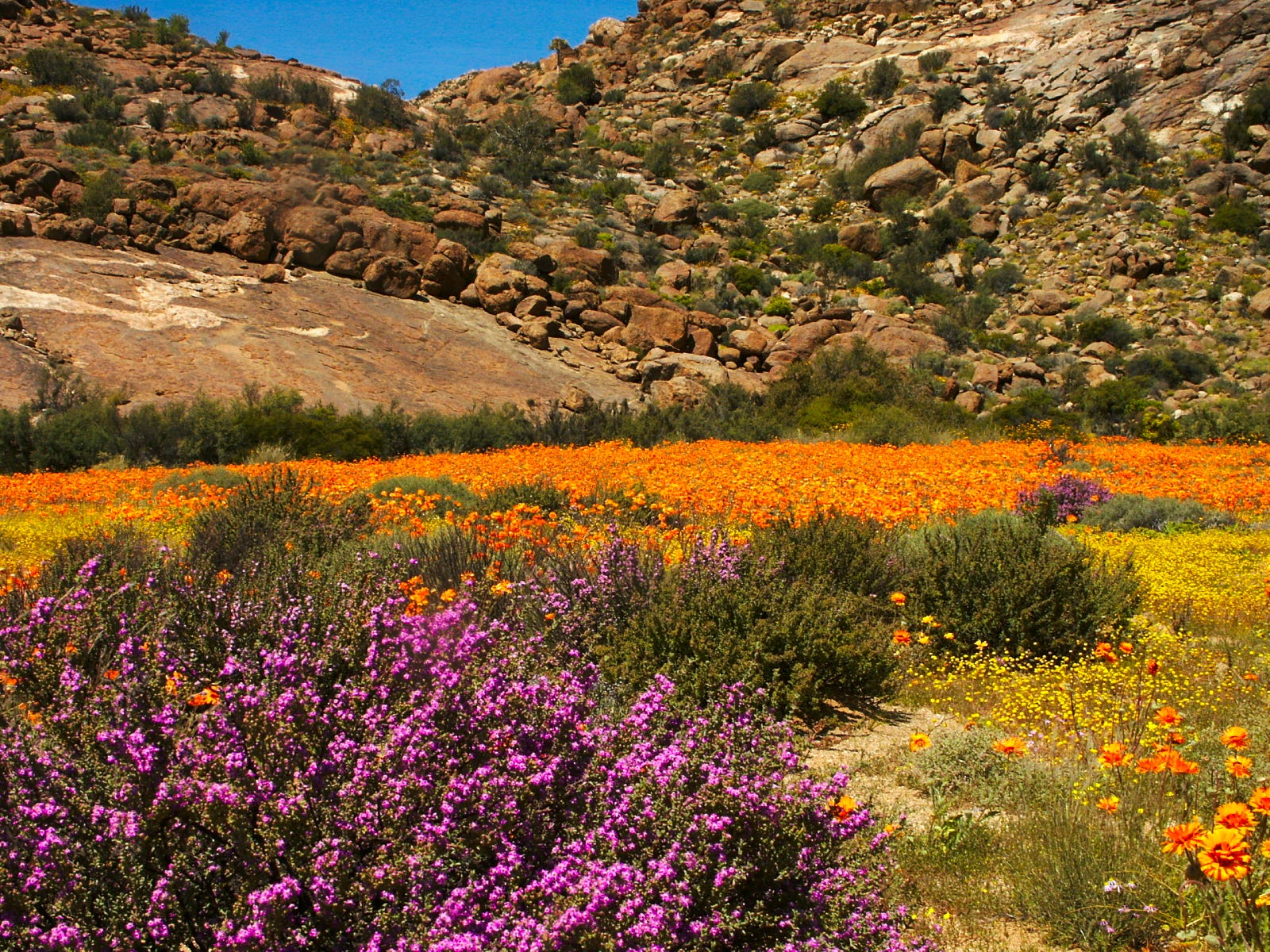
Anyone who has seen Namaqualand in flower season knows this rhythm. Most of the year, the land is dry and dormant. For a few weeks, the fields erupt with colour, life, and density before fading again. The bloom isn’t permanent; the return is.
The copper waited almost two centuries for its return. When commercial extraction began in the 1850s, it did so under conditions the Nama never controlled. They would not benefit equally. Foreign capital drove the process. Labour systems drew workers from distant communities under compulsion as much as choice. Export routes moved value out of Namaqualand toward European markets and shareholders.
The ore was known. The knowledge was indigenous. But the terms of extraction were not.
The groundwork laid by centuries of knowing the hills set the stage for what followed: the Blue Mine at Springbok, the extraordinary grades at Okiep, the narrow-gauge railway from Port Nolloth, and the communities drawn to the copper belt. These developments bridge the earlier era with the arrival of modern extraction.
The copper mountains were always there. The question that runs through every chapter of this story is not who found them, but why. It is who decided what happened next, and who bore the cost.
Next: Springbok, the Blue Mine, and the making of the world’s richest copper district.
Further reading (accessed on 13 March 2026):
Precolonial Mining and Metallurgy in Southern Africa
-Ochre communities of practice in Stone Age Eswatini— Linstädter et al., *Nature Communications* (2024). Open access via PMC:
https://pmc.ncbi.nlm.nih.gov/articles/PMC11502791/
-Lion Cavern Ngwenya – The Oldest Ochre Mine in the World— German Archaeological Institute news release:
https://www.dainst.org/en/newsroom/lion-cavern-ngwenya-the-oldest-ochre-mine-in-the-world/505
-2000 years of indigenous mining and metallurgy in southern Africa — a review— Duncan Miller, *South African Journal of Geology* (1995):
https://journals.co.za/doi/pdf/10.10520/EJC-92a11d85b
-Pre-colonial mining in southern Africa— Hammel, White, Pfeiffer & Miller, *SAIMM Journal* (2000):
https://www.saimm.co.za/Journal/v100n01p049.pdf
-Rooiberg revisited – the analysis of tin and copper smelting debris— Baumann et al., *Historical Metallurgy* (2021):
https://www.hmsjournal.org/index.php/home/article/view/201
-Iron Fabrication during the “Age” of Tin and Bronze in the Southern Waterberg of Limpopo Province, South Africa— Bandama et al.:
https://journals.udsm.ac.tz/index.php/sap/article/view/5088
-The archaeology and technology of metal production in the late Iron Age of the Southern Waterberg, Limpopo Province, South Africa(PhD thesis):
https://open.uct.ac.za/server/api/core/bitstreams/d86159f1-ddbd-46f0-b9b7-53e9afee0401/content
Long-Distance Stone Transport
-Provenancing of silcrete raw materials indicates long-distance transport to Tsodilo Hills, Botswana, during the Middle Stone Age— Nash et al.:
https://www.sciencedirect.com/science/article/abs/pii/S0047248413000274
-African Craftspeople Journeyed Long Distances to Obtain Perfectly Colored Stones— *Archaeology Magazine* news on the same research:
https://archaeology.org/news/2025/07/16/african-craftspeople-journeyed-long-distances-to-obtain-perfectly-colored-stones/
The VOC, Bullion and Asian Trade
-Dutch East India Company (overview)— Wikipedia:
https://en.wikipedia.org/wiki/Dutch_East_India_Company
-Dutch East India Company (DEIC)/VOC— South African History Online:
https://sahistory.org.za/article/dutch-east-india-company-deicvoc
-Precious Metals and Commerce: The Dutch East India Company in the Indian Ocean Trade— Om Prakash (book page):
https://www.routledge.com/Precious-Metals-and-Commerce-The-Dutch-East-India-Company-in-the-Indian/Prakash/p/book/9780860784340
-The VOC, the Dutch East India Company, 1602–1799— PDF survey (good on bullion flows):
https://bpb-us-w2.wpmucdn.com/sites.umassd.edu/dist/4/628/files/2017/02/thevoc.pdf
-What Was the First Company to Issue Stock?— Investopedia (VOC as first publicly traded company):
https://www.investopedia.com/ask/answers/08/first-company-issue-stock-dutch-east-india.asp
Van der Stel and the 1685 Namaqualand Expedition
-Simon van der Stel— biography:
https://en.wikipedia.org/wiki/Simon_van_der_Stel
-Diary of a journey made by Governor Simon van der Stell … to the country of the Amaquas, in the year 1685— *South African Quarterly Journal* (journal transcription):
https://journal.ru.ac.za/index.php/saqj/article/view/2639
-Diary of a journey made by Governor Simon van der Stell …(related article):
https://journal.ru.ac.za/index.php/saqj/article/view/2617
-A map and its copy of Governor Simon van der Stel’s expedition to Namaqualand (1685): an enquiry into their visual values— *Historia* article:
https://repository.up.ac.za/bitstreams/14bcc00b-7450-4f0b-b6c1-98509e46ca8f/download
-Journal on Namaqualand – Director’s Choice Uncut— Trinity College Dublin exhibition, with context on the manuscript:
https://www.tcd.ie/library/exhibitions/directors-choice/namaqualand/
Namaqualand Copper Mining (19th–20th Centuries)
-Aspects of the History of Copper Mining in Namaqualand— John M. Smalberger, MA thesis (UCT):
https://open.uct.ac.za/items/bd31ef55-7a87-4996-b0eb-a1a853c00e15
-The Legacies of Copper Mining in Namaqualand— UWC mini-thesis entry:
https://uwcscholar.uwc.ac.za/items/adbad382-b84e-458c-94c0-3a8b54d079d5
-History of the Okiep Copper District, Namaqualand, Northern Cape Province, South Africa— B. Cairncross, *Mineralogical Record* abstract:
https://pure.uj.ac.za/en/publications/history-of-the-okiep-copper-district-namaqualand-northern-cape-pr
Port Nolloth, Railways and Infrastructure
-Namaqualand Railway— overview:
https://en.wikipedia.org/wiki/Namaqualand_Railway
-Nababeep – The Namaqualand Copper Mine Railway: A Brief History**:
http://steam-locomotives-south-africa.blogspot.com/2010/07/nababeep-namaqualand-copper-mine.html
-Richard Thomas Hall — Railwayman in a Remote Part of the Colony— *The Heritage Portal*:
https://www.theheritageportal.co.za/article/richard-thomas-hall-railwayman-remote-part-colony
General Online Overviews and Context
-1684 The Copper Mountain of Namaqualand— South Africa Online:
https://southafrica.co.za/1684-the-copper-mountain-of-namaqualand.html
-1852 The Rise of the Namaqualand Copper Industry— South Africa Online:
https://southafrica.co.za/1852-the-rise-of-the-namaqualand-copper-industry.html
-1854 Namaqualand Copper Fever— South Africa Online:
https://southafrica.co.za/1854-namaqualand-copper-fever.html
-History of mining activities in the Northern Cape— Northern Cape Mining Community:
https://www.northerncapeminingcommunity.co.za/mining-in-the-northern-cape/history-of-mining-in-the-northern-cape
-Simon van der Stel Timeline— South African History Online:
https://www.sahistory.org.za/article/simon-van-der-stel-timeline