MiningIsHuman Story 4 - Springbok District
A Journey Through Southern Africa’s First Industrially Mined Metal

The copper was always there. The Nama knew it first. What arrived in the 1850s was not discovery. It was capital — and capital arrived with terms.
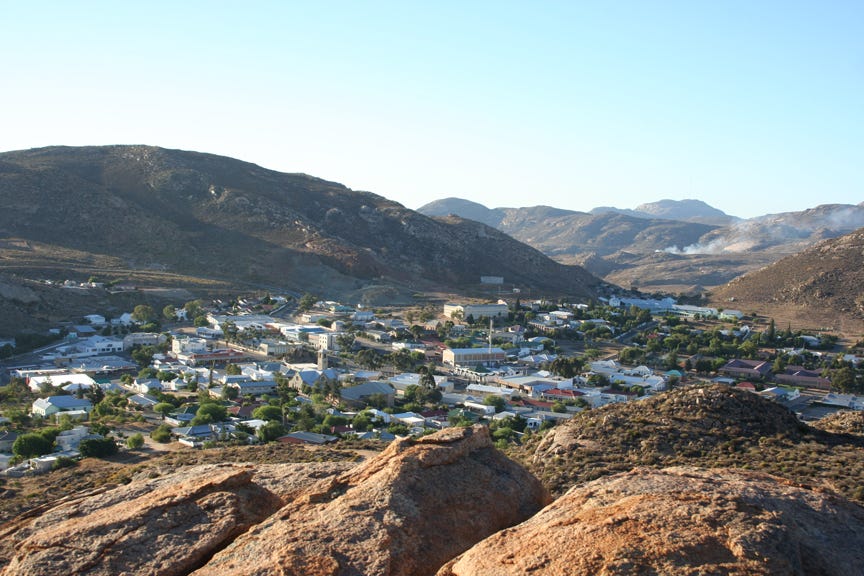
Long before a company drove the first shaft, the Springbok district was home to people with names, languages, land, and purpose. Nama communities had moved through Namaqualand for centuries, their relationship with the copper mountains practical and intimate. Baster families had settled later, under conditional land titles negotiated with the colonial administration — fragile tenure, but tenure nonetheless. The district had its own rhythms, its own economy, its own sense of who belonged and on what terms.
In 1852, Phillips & King acquired land for what became the Blue Mine. The acquisition was made possible by the withdrawal of the conditional land title of the Cloetes, a Baster family. They lost their land. The mine gained its foundation. That sequence — dispossession preceding extraction — was not incidental to the copper industry’s beginning in Springbok. It was structural. The mine did not arrive in an empty landscape. It arrived in one it first had to clear.
The Blue Mine was the beginning of something larger. As prospecting pushed outward from Springbok toward Okiep, Concordia, and Nababeep, a commercial architecture took shape around it. The Cape Copper Company consolidated the main operations, raised capital in London, and began building the infrastructure that would turn Namaqualand’s ore into an export industry.
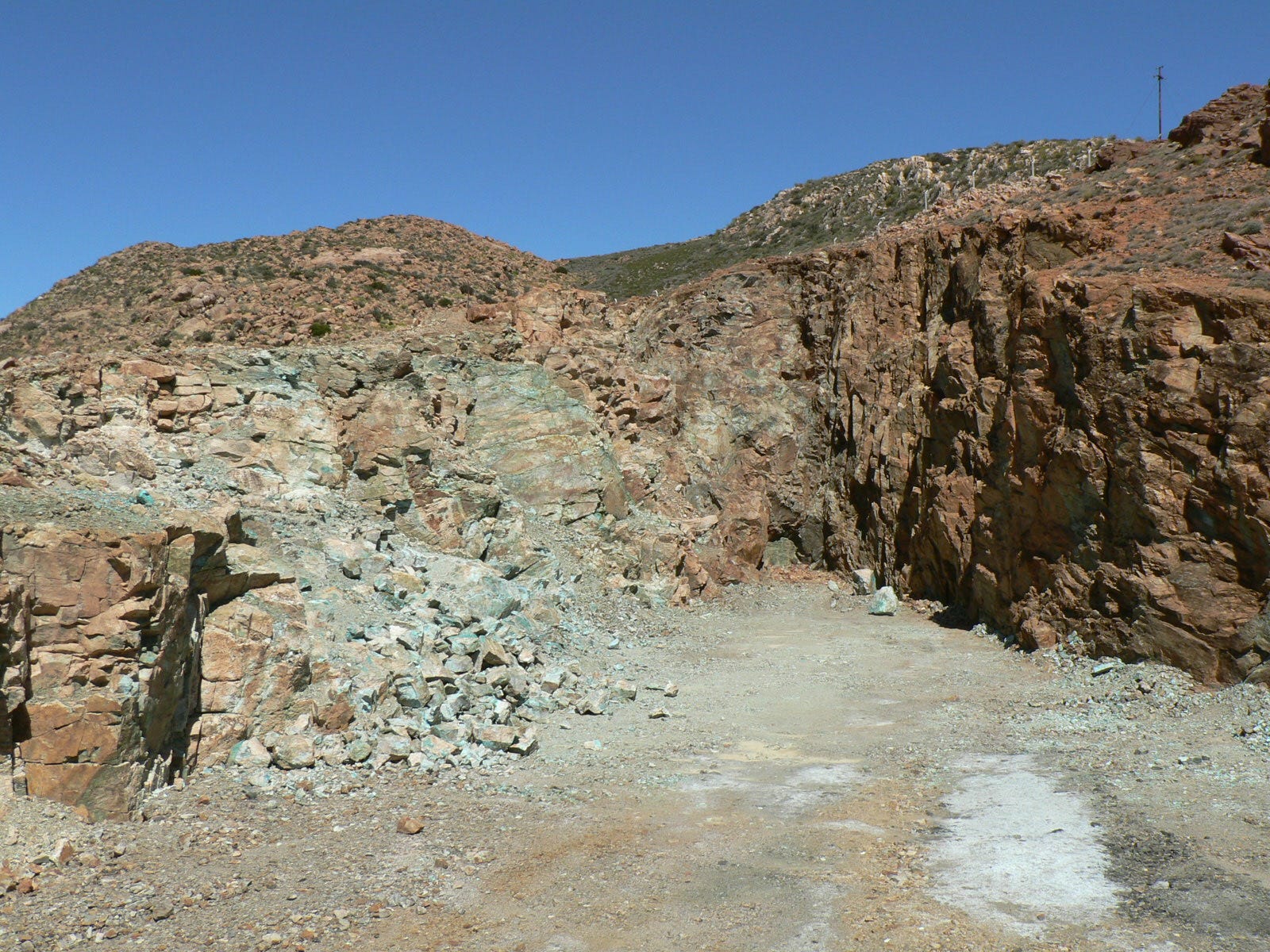
What emerged in Springbok was not merely a mine. It was the originating model for industrial mining across Southern Africa — assembled here in full, before Kimberley’s diamonds, before the Witwatersrand’s gold, before any of the deposits that history remembers more readily. Foreign capital mobilised from London. Export infrastructure driven across hostile terrain. Migrant labour recruited under compulsion as much as choice. Compound housing that kept workers close to the mine and away from the town. Boom-bust cycles. Integration into global commodity markets on terms set elsewhere. Every feature that would define Southern African industrial mining for the next century and a half was present in Namaqualand first — in precursor form — in the 1850s and 1860s. Springbok did not anticipate the template. It originated it.
The infrastructure unlock
The copper was rich. The logistics were brutal. The ore sat in the hills around Springbok and Okiep, hundreds of kilometres from the nearest viable port, across terrain that offered no road, no rail, and almost no water. Moving bulk ore through that landscape on ox-wagon was expensive enough to make even high-grade deposits marginal.
The solution was the Port Nolloth railway. Approved in 1869, completed to Okiep by 1876, the narrow-gauge line ran 150 kilometres across the arid Namaqualand landscape that Van der Stel had crossed with wagons, oxen, and a large expedition almost two centuries earlier. It was an engineering achievement of real ambition for its time and place.
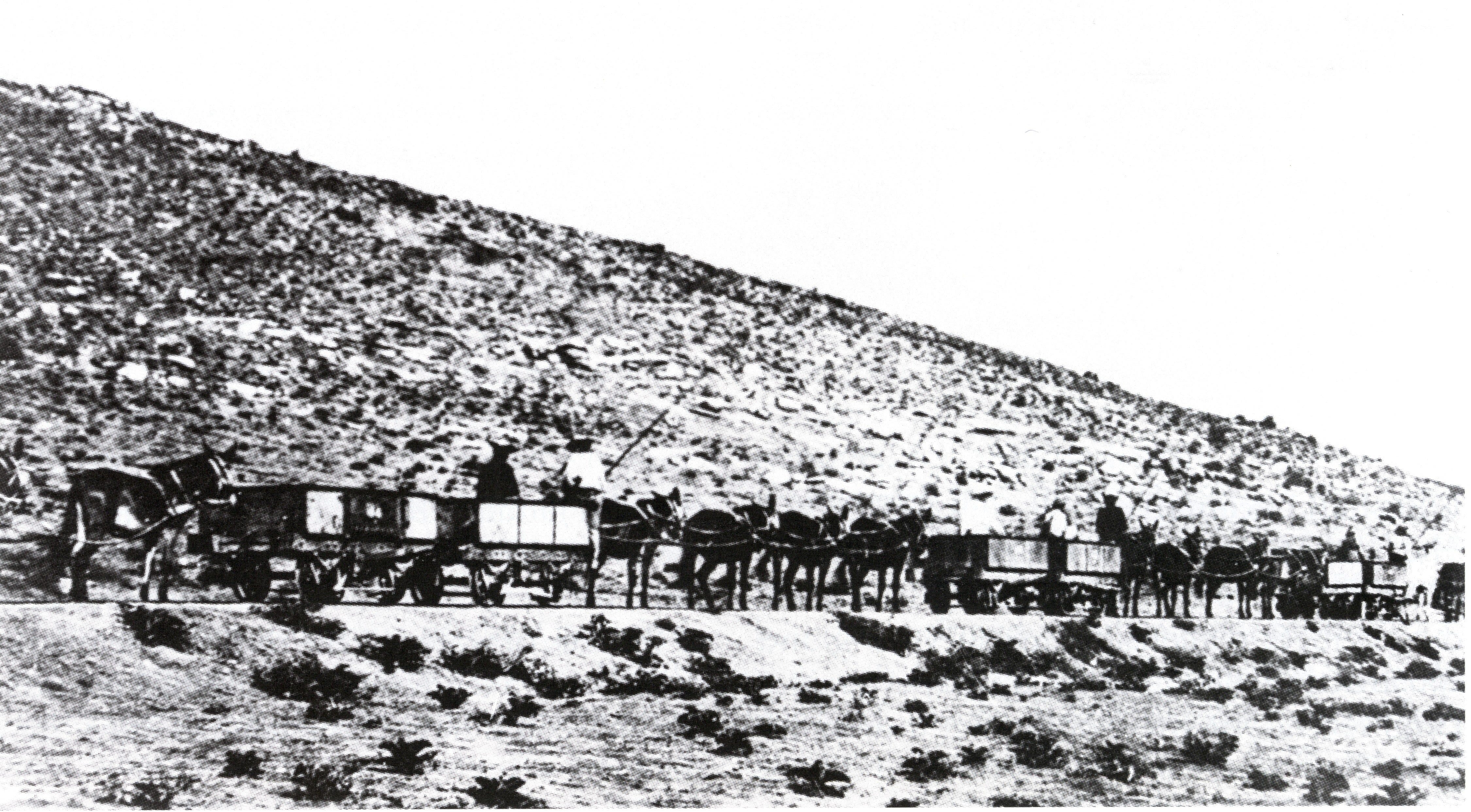
It was also more than a mineral export route. For the communities along it — Springbok, Steinkopf, Kamiesberg — the railway meant connection: supplies arriving, knowledge moving, business possible, jobs accessible without leaving home. A corridor changes what is reachable. The Port Nolloth line changed what the district could be, for mining capital and for the people the mining capital depended on.
What the railway unlocked, above all, was Okiep.
The world’s richest copper mine
To understand what Okiep was, comparison matters. Most copper ore mined globally today averages between 0.5 and 2 percent copper. Deposits considered high-grade typically fall in the 1 to 2 percent range. Chilean copper, dominant in global markets through the nineteenth century, sometimes ran at up to 25 percent in its richest workings. Michigan’s famous copper fields produced spectacular masses of almost pure native metal, but averaged far lower grades in bulk mining
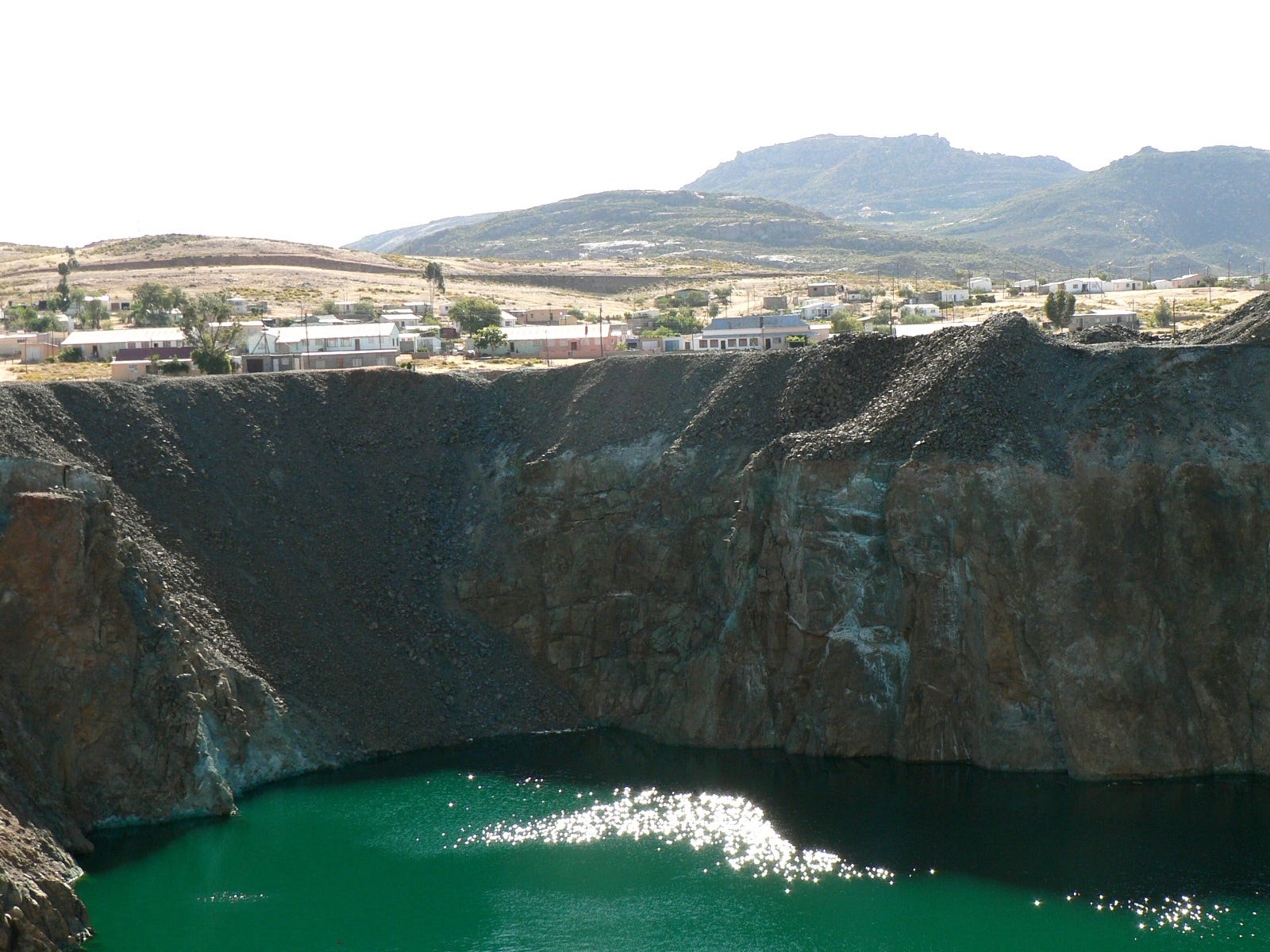
Okiep’s sustained shipments ran at up to 30 percent copper concentrate. It was widely described at the time as the richest copper mine in the world.
The timing was as important as the grade. By the 1870s, Cornwall’s mines were exhausted. Chilean output was declining. Britain’s Industrial Revolution required copper in quantities that traditional sources could no longer supply — for telegraph wire, locomotive fireboxes, and the electrical systems of a modernising world. Namaqualand’s ultra-high-grade ore arrived precisely as industrial demand began to outpace supply. The district that Van der Stel had confirmed and abandoned in 1685 became, two centuries later, one of the most strategically important copper sources on earth.
The people on the dressing floors
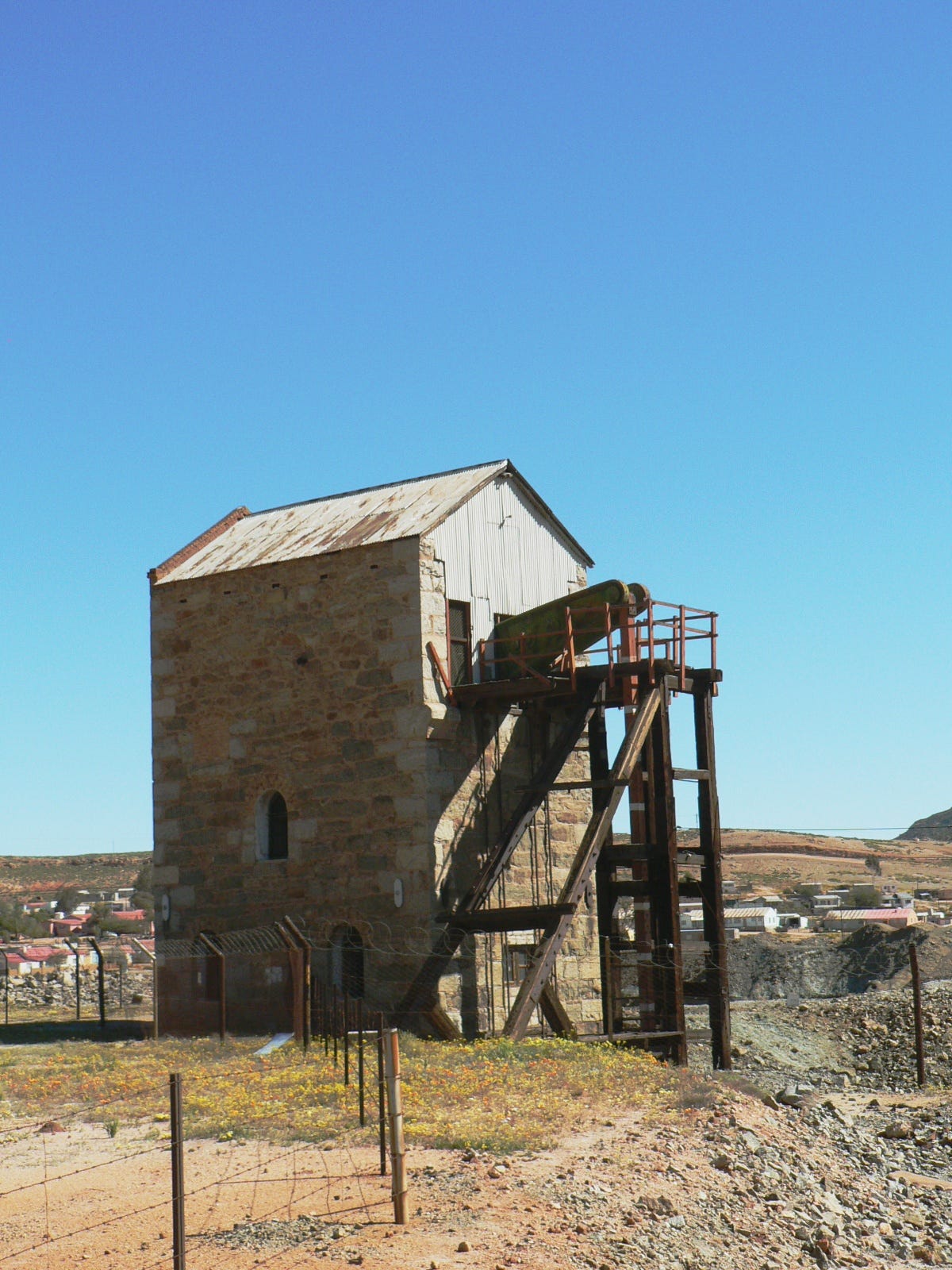
The Cape Copper Company needed labour at scale. It recruited from far beyond Namaqualand — Xhosa workers from the eastern Cape, Batswana from the north, Damara and Herero from present-day Namibia. Alongside the Nama, they were housed in compounds that restricted movement and separated migrant workers from the towns their labour was building. The compound system that would later harden in the diamond fields at Kimberley and on the Witwatersrand gold mines took its early form here, in Namaqualand, in the 1850s and 1860s.
Women worked on the dressing floors — sorting, cleaning, and grading ore — in domestic labour, and in the informal economies that sustained mining towns. Their work was essential and largely unrecorded. Historian Kai Herzog documents systematic sexual violence in nineteenth-century Namaqualand mining camps, routinely ignored by colonial magistrates whose function was to keep the labour supply stable, not to protect the people within it. The violence was not incidental. It was enabled by a system that rendered certain people invisible to the law while making their bodies and labour entirely visible to capital.
The migrant labour compound was designed for control, not habitation. It kept workers close to the mine and away from the town. It made family life structurally difficult and permanent settlement financially impossible. The men who sank Okiep’s shafts and raised its extraordinary ore lived inside a system designed, above all, to keep them temporary.
One week’s pay
In 1919, the Cape Copper Company closed. Not gradually — in a day.
Workers received one week’s pay. Shareholders, over the life of the operation, had realised a return of more than twenty-seven times their original investment. The district that had given South Africa its first colonial industrial metal export was left with abandoned shafts, no wages beyond that single week, and families whose entire economic architecture had been built around a mine that was simply gone.
The Springbok district went quiet. The infrastructure remained. The shafts remained. The people remained. The capital did not.
For nearly two decades, the district waited.
What Newmont built
In 1937, Okiep Copper Company formed, with Newmont Mining Corporation as its largest shareholder. Newmont was not a speculative operator. It was a company that understood long time horizons — the descendant of the Newmont Company that had taken a 25 percent stake in the creation of Anglo American in 1917, placing it near the centre of early Witwatersrand gold mining
What Newmont brought to Springbok was patience. Over four decades, it rebuilt the district into a functioning modern mining complex. New mines opened. Pipelines brought water from the Buffels River. Exploration added dozens of deposits. Output settled at between thirty and forty thousand tonnes of copper annually. Dividends were paid. Wages were paid. For two generations, that stability anchored life in Springbok, Okiep, and Nababeep in ways that the Cape Copper Company era never had.
Newmont, like all South African mining companies in the 20th century, operated through the era of grand apartheid. The hostel system it inherited was not merely industry practice — it was legally mandated. Closing the compounds, dismantling the migrant labour architecture, normalising family housing: these were not options available to a single operator under the law as it stood. The racial hierarchies of the workplace were those of mid-twentieth century South Africa — structural, enforced, and not Newmont’s invention.
The Truth and Reconciliation Commission would later find that the mining industry as a whole — not any single company by exception — had benefited from these systems and had not done enough, during the apartheid years, to address the migrant labour patterns they perpetuated. That finding was industrywide. The pain it named ran through most of the twentieth century and into the twenty-first, across every district, every company, every hostel block that kept men away from their families and their communities away from the towns their labour built.
In 1984, Newmont sold to Goldfields. Goldfields was primarily a gold company, and copper in a period of weak prices was not where its attention lived. The Okiep operation was managed through decline rather than reinvented. Goldfields subsequently sold its stake. The successor in title began closure procedures in 2004. The operations wound down over the next several years.
The plant at Okiep was dismantled. It was transported thousands of kilometres into central Africa — to Ruashi and Kinsenda — and reassembled there, where it now produces copper for different owners in a different country. Springbok watched its industrial infrastructure leave on trucks.
For twenty years, the district was quiet again.
The third return
Copper is back in Springbok.
Copper 360 listed in 2023 and deployed plants to re-mine old dumps around Nababeep. A third plant came online in 2024. The company is producing now. Orion Minerals has taken the longer view — rebuilding the Okiep database, developing a modern underground and open-pit complex, with recent drill results among the highest-grade intercepts in South Africa in decades.
Both operate under the Mining Charter. Both face the old challenges — water, logistics, communities that remember what happens when owners leave. Those memories run deep in Springbok. They are not cynicism. They are institutional knowledge, earned across three cycles of arrival and abandonment.
Copper has died and returned in this district three times. The ore remains. The question the district has been asking since 1850 remains equally unanswered: when the cycle turns again, what will have been built that lasts?
What came next
Springbok originated the Southern African mining template. What followed were deposits that tested it — sometimes confirmed it, sometimes challenged it, sometimes broke it entirely.
At Prieska, 31 million tonnes of copper-zinc ore sat in the ground through a 1991 closure, waiting for a cycle that has now turned. At Palabora in Limpopo, a hill that Iron Age miners worked around 770 AD became South Africa’s most enduring copper mine — twelve centuries of extraction, three ownership cycles, and a legacy measured not in tonnes but in roads, schools, and institutions. At Messina, the same centuries of indigenous knowledge, the same colonial claim, a radically different answer to the question of what gets left behind.
Further reading (accessed on 13 March 2026):
Namaqualand Copper History — General
-1684 The Copper Mountain of Namaqualand— South Africa Online. Van der Stel’s expedition and Nama copper knowledge:
https://southafrica.co.za/1684-the-copper-mountain-of-namaqualand.html
-1852 The Rise of the Namaqualand Copper Industry— South Africa Online. Phillips & King and the early mining rush:
https://southafrica.co.za/1852-the-rise-of-the-namaqualand-copper-industry.html
-1854 Namaqualand Copper Fever— South Africa Online. The speculative boom that followed:
https://southafrica.co.za/1854-namaqualand-copper-fever.html
-1860 Mining Business in Namaqualand— South Africa Online. Early commercial operations:
https://southafrica.co.za/1860-mining-business-in-namaqualand.html
-Mineral Wealth of Namaqualand— South Africa Online. Overview of mineral history including Nama knowledge of copper:
https://southafrica.co.za/mineral-wealth-of-namaqualand.html
-1870 The Copper Wonder of Namaqualand— South Africa Online. Okiep described as the “richest copper mine in the world,” including references to women on dressing floors:
https://southafrica.co.za/1870-the-copper-wonder-of-namaqualand.html
-1914 The Copper Companies of Namaqualand— South Africa Online. Cape Copper Company operations, the 1919 closure, shareholder returns, and the famous “one week’s pay” dividend:
https://southafrica.co.za/1914-the-copper-companies-of-namaqualand.html
The Blue Mine and Dispossession
-Blue Mine, Springbok— Mindat. Geological and historical record of the Blue Mine:
https://www.mindat.org/loc-123286.html
-The Sale of the Farm Melkboschkuil— UWC Scholar. Master’s thesis abstract on the Cloete family land sale and its contestation:
https://uwcscholar.uwc.ac.za/items/74484a8a-176d-4a42-af15-b6e82201ade5
-The Legacies of Copper Mining in Namaqualand— UWC Scholar. Academic study of mining’s long-term impact on the district:
https://uwcscholar.uwc.ac.za/items/adbad382-b84e-458c-94c0-3a8b54d079d5
Port Nolloth Railway
-Namaqualand Railway— Wikipedia. Construction dates, gauge, and route details:
https://en.wikipedia.org/wiki/Namaqualand_Railway
-Namaqualand 0-6-0T Locomotives— Wikipedia. Rolling stock and operational history:
https://en.wikipedia.org/wiki/Namaqualand_0-6-0T
Sexual Violence and Labour
-Intimacy, Labour and Sexual Violence— Kai Herzog (2024). Study of Nama and Baster women in Namaqualand’s copper mines:
https://openhsu.ub.hsu-hh.de/entities/publication/20272
Compound System and Migrant Labour
-Compound (Migrant Labour)— Wikipedia. Origins in Namaqualand and later formalisation at Kimberley:
https://en.wikipedia.org/wiki/Compound_(migrant_labour)
Newmont and Anglo American
-Newmont— Wikipedia. Founding history including the early shareholding in Anglo American:
https://en.wikipedia.org/wiki/Newmont
-Brief History of Newmont— PESTLE Analysis. Timeline from the 1916 founding through Okiep and later developments:
https://pestel-analysis.com/blogs/brief-history/newmont
-Who Owns Newmont— PESTLE Analysis. Ownership structure and Anglo American founding stake context:
https://pestel-analysis.com/blogs/owners/newmont
Okiep and Modern Revival
-Okiep— Wikipedia. Town history and mining context:
https://en.wikipedia.org/wiki/Okiep
-Okiep Copper Project— Orion Minerals. Current exploration and development plans:
https://www.orionminerals.com.au/projects/okiep-copper-project/
Copper 360
-Copper 360 Lists on JSE— MiningMX. 2023 listing and investor context:
https://www.miningmx.com/news/base-metals/53022-copper-360-lists-on-jse-and-reveals-a-surprising-new-investor/
Plant Relocation to DRC
-Ruashi Mine— Wikipedia. Confirmation of the Okiep plant relocation:
https://en.wikipedia.org/wiki/Ruashi_mine
-Kinsenda Copper Mine— DRA Global. The second DRC operation using Namaqualand equipment:
https://www.draglobal.com/projects/kinsenda-copper-mine/
Prieska and Palabora
-Prieska Copper Zinc Project— Orion Minerals. Resource size, 1991 closure, and restart plans:
https://www.orionminerals.com.au/projects/prieska-copper-zinc-project/
-About Us— Palabora Mining Company. Historical and operational overview:
https://www.palabora.com/About-Us
Cornwall Decline (Comparative)
-Cornish Mining: A Short History— Bernard Deacon. Peak and collapse of Cornish copper mining:
https://bernarddeacon.com/mining/cornish-mining-a-short-history/
-Industry in Cornwall— Cornwall Heritage Trust. Broader industrial history:
https://www.cornwallheritagetrust.org/timeline/industry-in-cornwall/
Van der Stel’s Expedition — Primary Source
-Diary of a Journey Made by Governor Simon van der Stel to the Country of the Amaquas (1685)— South African Quarterly Journal transcription:
https://journal.ru.ac.za/index.php/saqj/article/view/2639
-Diary of a Journey Made by Governor Simon van der Stel to the Country of the Amaquas (1685)— South African Quarterly Journal transcription:
https://journal.ru.ac.za/index.php/saqj/article/view/2639