
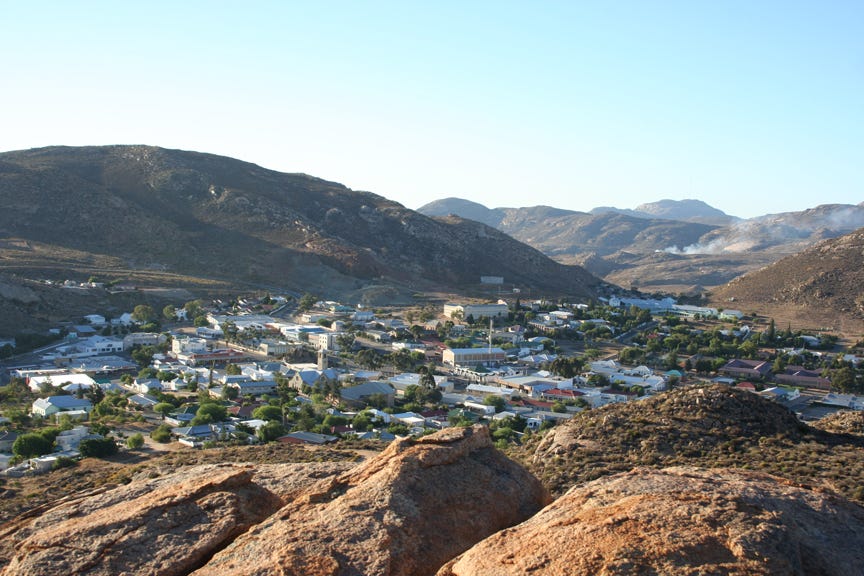
Springbok district was home to diverse people, cultures, languages, and ways of living.
Nama communities had for centuries moved through Namaqualand. Baster families arrived later, settling under conditional titles amid colonial expansion. In 1850, Phillips & King acquired land for the Blue Mine after a Baster family’s conditional land title was withdrawn, a loss that displaced Nama and Baster families and removed existing livelihoods.
Settlers of European ancestry also came, including Lithuanian Jewish traders and Cornish miners, who became part of Springbok’s early fabric. Jewish traders linked farms, mines, and towns through shops, hotels, and credit. Cornish miners brought deep-shaft expertise and safety practices. Most moved on, but their traces shaped the mines as names faded.
Mining camps needed labour. Xhosa workers from the eastern Cape, Batswana from the north, and Damara and Herero from present-day Namibia were drawn in by necessity and by hut taxes and pass laws that narrowed alternatives. Records called them “Native labour,” but they maintained distant family ties and sent remittances.
Alongside the Nama, they lived in segregated compounds that restricted movement and family life, keeping migrant workers apart from the towns they built. The compound system functioned as an early form of labour control, taking shape in Namaqualand decades before similar arrangements hardened in the Diamond fields and later on the Rand.
Women worked on the dressing floors, in domestic labour, and in informal economies sustaining mining towns. Migration opened limited agency for some Nama and Baster women but exposed many to violence. Historian Kai Herzog documents systematic sexual abuse in nineteenth-century mining camps, often ignored by colonial magistrates. This violence reinforced existing racial and gender hierarchies, limiting women’s autonomy in ways that did not simply disappear with time.
When modern mining companies arrived, they entered a landscape already shaped by these structures and their long consequences. Years later, the Truth and Reconciliation Commission would note that South African mining companies operated within and benefited from systems of inequality.
By the 1950s, apartheid’s Population Registration Act imposed itself on Springbok’s people. Diversity was flattened into a racial hierarchy, making people legible to the state but often invisible to history.
Remembering Springbok’s people is not nostalgia. It is a refusal to let their displacement, complexity, and agency vanish.
#MiningIsHuman in the Springbok District means honouring those already there, those who joined later, and all who built the towns and mines the colonial economy depended on. And who stayed as mines closed and local economies collapsed. Their courage and insistence on dignity speak of roots deeper than any mine.
This story is also on LinkedIn, published on 27 Jan 2026.