
In 1685, Simon van der Stel led a hundred men from the colony into the Namaqualand. He found the Koperberge and high-quality copper at depth. But without a harbour or road, the discovery had no value. It took almost 200 years for people to learn this lesson.
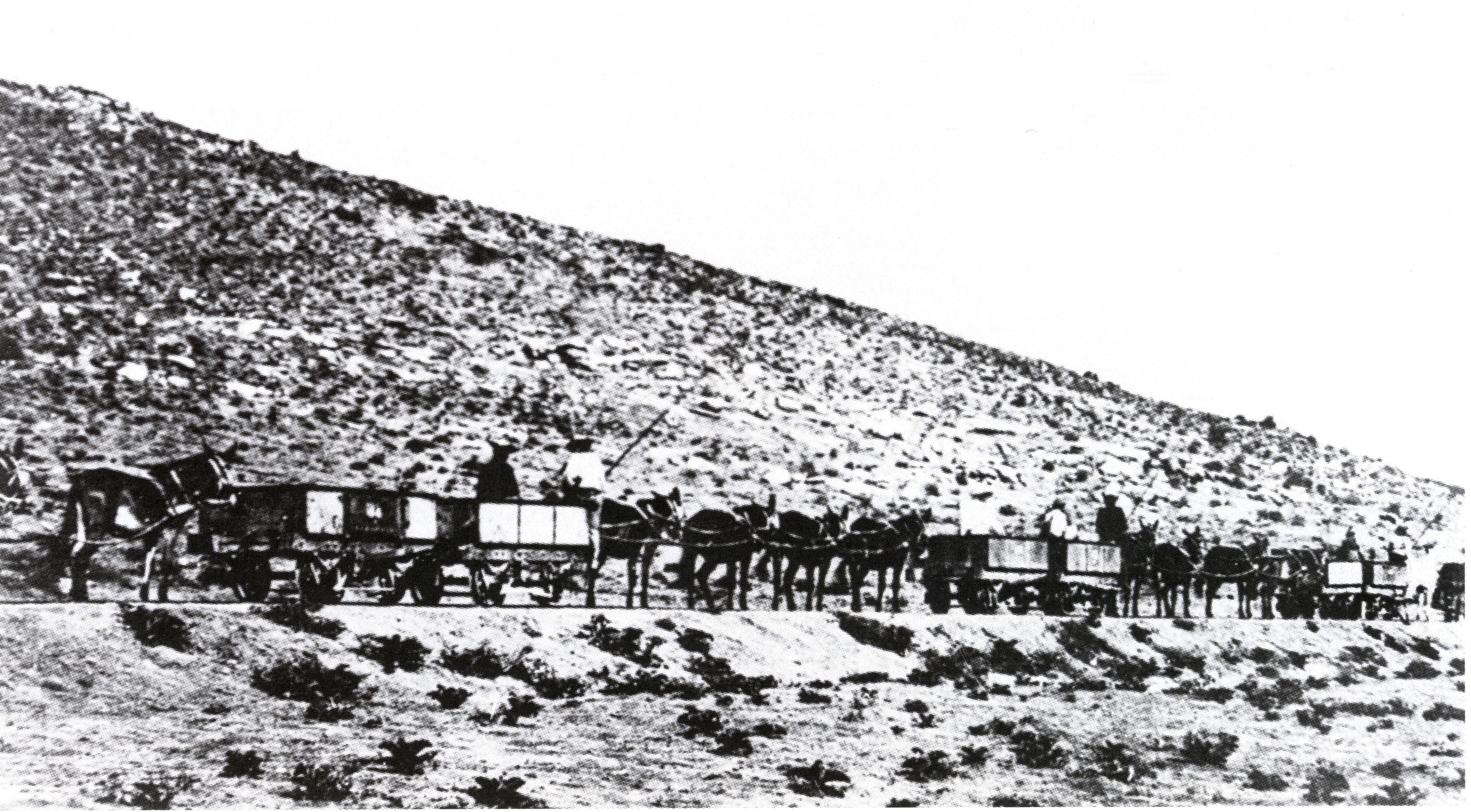
In 1869, the Cape Government approved a narrow-gauge railway from Port Nolloth. By 1876 it reached O’kiep, crossing the arid landscape Van der Stel explored. The same deposits were now within reach. For a while, distance was no longer an impossible barrier.
The line closed in the early 1940s and the tracks were removed. The Northern Cape’s first corridor was left behind. Once again, distance became a problem.
When the Port Nolloth line reached Okiep, the corridor became more than a mineral export route. For communities along the route — Springbok, Steinkopf, Kamiesberg — it meant connection: supplies, knowledge, business, and jobs without leaving home. A corridor benefits everyone it touches. That lesson from the 1870s is still true today.
The Sishen–Saldanha line is 861 km long and has capacity to move 67 million tons of iron ore each year. Manganese routes from the Kalahari are built for another 16 million. Transnet operates some of the world’s longest trains: iron ore trains of 342 wagons, manganese up to 375, both nearly four kilometres long. In 2019, a 33-year-old woman from the West Coast fishing village of Paternoster — a village deeply connected to the region's indigenous heritage — was the driver of the world's longest production train. That achievement was 334 years in the making.
But both corridors have underperformed for years. In 2022 and 2023, volumes dropped below capacity and only recovered to 56 million tons, still far from the 67 million target. Tens of millions of tons were mined and then stockpiled, unable to move. Cable theft, delayed maintenance, and derailments made things worse. The distance is the same, but our ability to bridge it has declined.
The line passes depots between Sishen and Saldanha — Groblershoop, Kenhardt, Loeriesfontein, Vredendal — each a workplace. When underperformance forced cutbacks in 2023 and 2024, consequences spread: depot crews lost shifts, port workers faced reduced throughput, supplier contracts were cut, and families in a province with 39.7% unemployment were hit. The corridor is a single system. When rail weakens, pain spreads to every depot, supplier, and household whose income traces back to a loaded wagon.
Van der Stel’s expedition failed for lack of a road. Today, the road, trains, and ore remain, but the system connecting them has weakened. Distance still decides what is possible. In 1685, geography was the problem. Now it is underinvestment.
This is a problem we can solve, which makes resolution more urgent.
This story is also on LinkedIn, published on 3 Mar 2026.