
Today, we start our PGM story arc. Two threads: Every Tuesday, stories of the major PGM mines of South Africa and Zimbabwe. Some Thursdays, a different channel of quieter context stories for those who want to go deeper — corporate genealogy, social history, the geology of the Bushveld and Great Dyke.
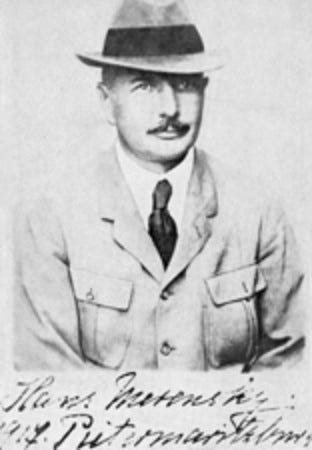
Today is the first of those occasional Thursday stories. And there is no better place to start than Hans Merensky, the man who first identified the vast PGM reserves in the Bushveld.
Born in 1871 at Botshabelo mission, Merensky studied geology in Berlin and returned to South Africa in 1904. During the post-Boer War boom, he described Bushveld tin deposits, including Zaaiplaats and Rooiberg.
Speculative stock trading, involving both his own funds and those entrusted by friends and family, left him insolvent in 1913. As a German national, he was interned at Fort Napier near Pietermaritzburg during World War I.
At 52, he considered himself a failure.
New opportunities soon emerged. In 1924, a farmer discovered platinum near Lydenburg and sent a sample to Merensky. Within weeks, Merensky traced what became known as the Merensky Reef, a 280-kilometre layer in the Bushveld Complex containing approximately 75% of the world’s known PGMs. Despite this discovery, he earned barely enough to settle his debts.
In 1926, he traveled to Namaqualand after diamond discoveries on the Atlantic coast.
Applying his “oyster line” theory, he recovered thousands of carats and sold his stake to the Oppenheimer-Barnato Group for over £1 million.
However, not all of Merensky’s actions are commendable. Syndicate partners who assisted him in reaching Namaqualand were excluded when he restructured the deal to his advantage. The broader consequence, government seizure of coastal mineral rights, dispossessed the Richtersveld Nama community of ancestral land—a harm addressed decades later by the Constitutional Court.
The diamonds Merensky helped uncover later flooded the market. Ernest Oppenheimer and the Barnato group used this crisis to take control of De Beers. Through his geological expertise, Merensky inadvertently contributed to shaping mining capital formation across the subcontinent for generations.
With his fortune, Merensky purchased Westfalia Estate, transforming degraded land into conservation areas and subtropical farms. Before his death in 1952, he donated 90% of his wealth to the Hans Merensky Trust.
Geologist, bankrupt, prisoner of war, prospector, entrepreneur, conservationist, and above all, human.
His legacy is visible. So are its complexities. And his imprint on memory. Mining has always been human before it was industrial. That is true in Merensky’s story as well.
This story is also on LinkedIn, published on 5 Mar 2026.