
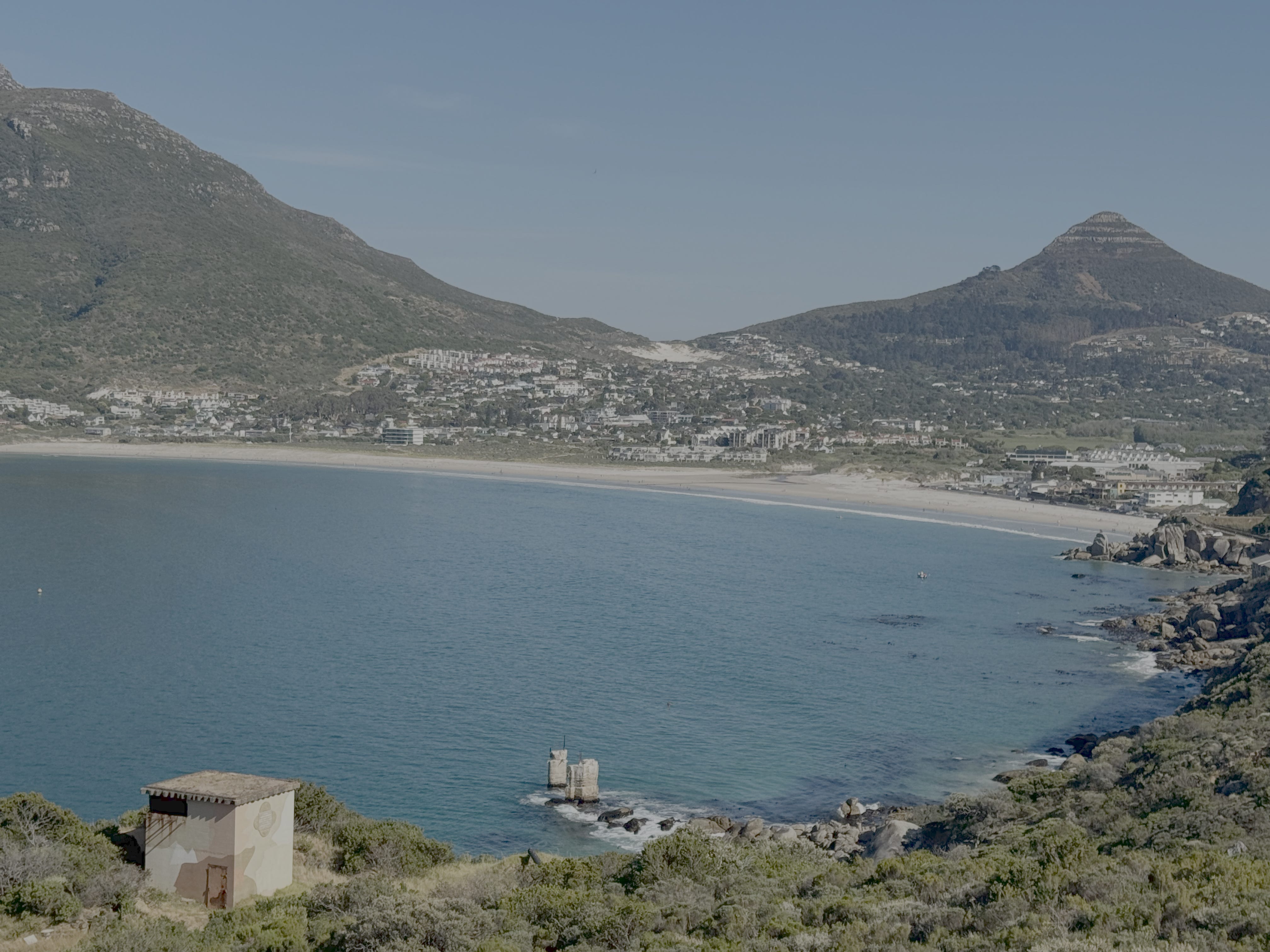
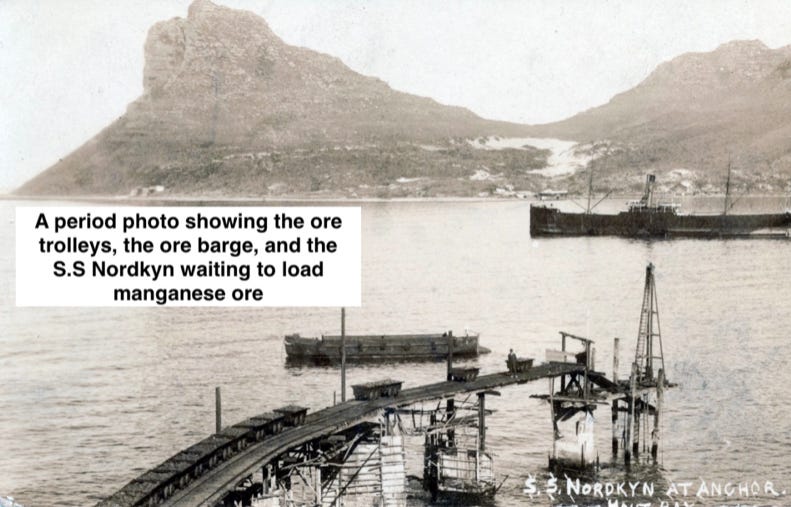
This is another proximate tale in my mining series. I’m sharing two images with this post: one from the Heritage Portal, and one taken from Chapman’s Peak when I visited the site recently.
Manganese was discovered above Hout Bay in 1873, but mining only began in 1910, in the years before the vast Northern Cape deposits shifted the centre of gravity for manganese mining. The ore sat high on Skoorsteenberg, in narrow veins that pinched tightly with depth. Today you reach it by hiking from the old East Fort. The incline was a little too steep for me, so I photographed the remains of the jetty from Chapman’s Peak.
This was a serious venture. Thirteen adits and shafts and a 700-metre steel chute to extract and drop ore to sea level. Below them, engineers built a system to move the ore: a crane lifted it into cocopans, out along a rail spur onto a jetty. Barges took the ore to ships anchored offshore. It was bold, expensive and technically sophisticated.
This was a determined attempt to overcome the same crushing logistical constraints that frustrated other early manganese ventures in the Cape mountains. Hout Bay solved the problem that defeated the others: how to move bulk ore down a cliffed coastline when there were no roads, no rail, and no harbour depth. What it could not solve was the quality of the ore itself. The grade was too low, the phosphorus too high, and the seam narrowed quickly with depth.
Some sources suggest more than 200 migrant labourers from India worked here on piecework soon after production began. We do not know their names, and we do not know whether they were contracted workers or those still caught in the fading shadow of indenture. We do know they blasted, dug and carried ore through steep sandstone for about a year.
In 1910 the mine produced about 5 000 tons. In 1911 it produced only 130. By 1912 it was over. One storm wrecked the two barges, but the truth is the mine had already collapsed beneath the chemistry of its own ore. I honour the individuals and investors who believed this could be a world-class manganese mine, who risked capital and reputation, and who lost a fortune in pursuit of that belief.
Mining is also about honouring its people. I hold in view the Khoe and San communities who once moved through these mountains. I recognise the Indian miners who worked this short-lived venture, and the local workers who supported them. I recognise the people of Hout Bay who watched a mine arrive with force and leave with silence.
Standing on Chapman’s Peak, I see again the gamble at the heart of mining everywhere: bold plans, hard work, and the risk that even the most sophisticated design can be humbled into silence by the earth itself. The mountain keeps the memory — quietly, long after the machinery is gone.
This story is also on LinkedIn, published on 28 Nov 2025.