
Beneath southern Africa lie two of the world’s most remarkable geological structures. Formed hundreds of millions of years apart and on different ancient foundations, they straddle two countries but tell the same story. Together, they provide about 80% of global PGM production.
I am a lawyer, not a geologist. What follows is my best attempt to explain what I have learned from people who are and what I have read.
Both structures formed when huge volumes of molten rock from the mantle pooled above Earth's oldest, most stable crust. As the magma cooled, minerals crystallized into layers. In some, sulphur acted like a sponge, concentrating metals into thin, rich bands. The value is locked into specific horizons miners can follow for hundreds of kilometres.
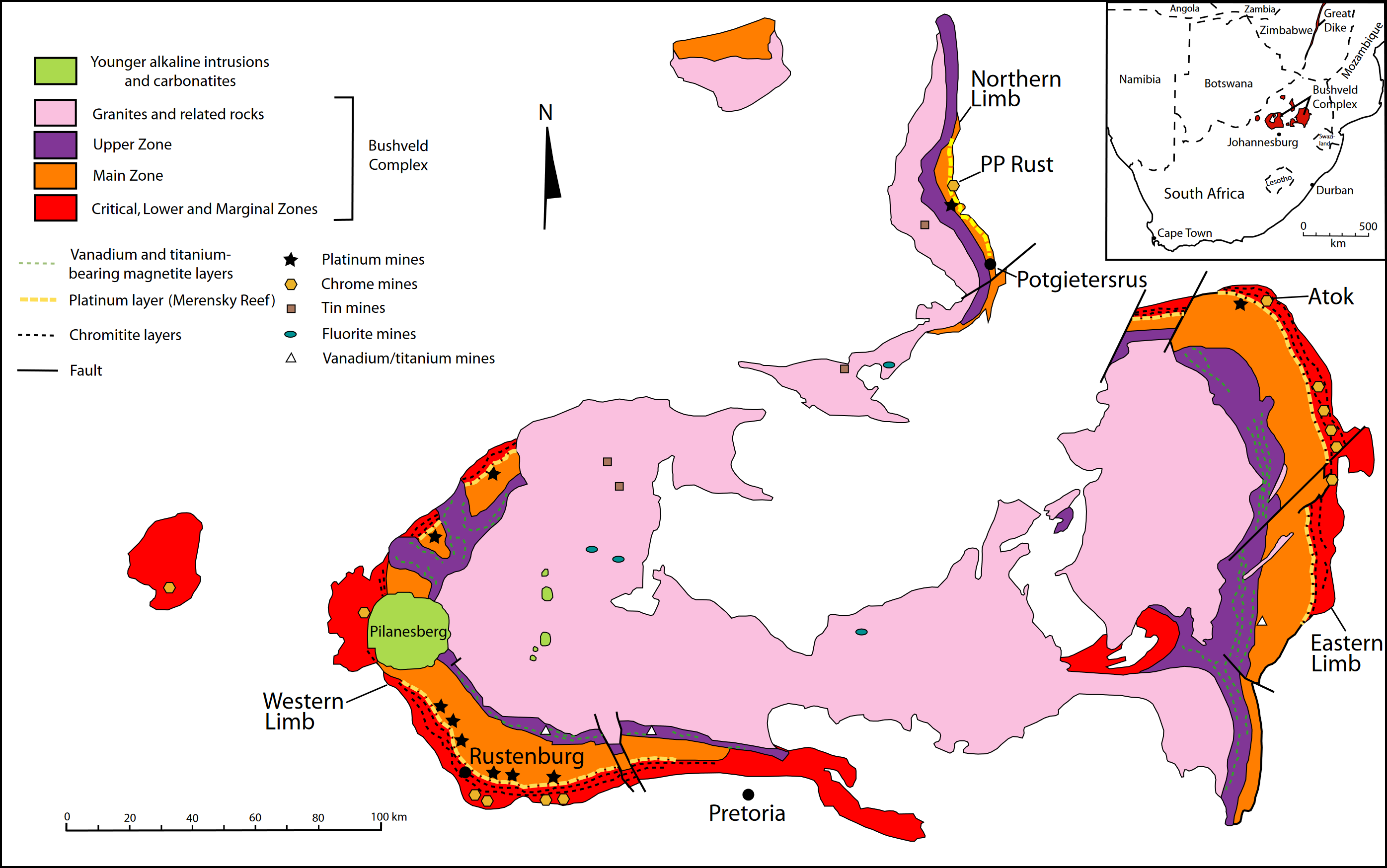
The Bushveld Igneous Complex in South Africa, the largest of its kind, covers half a million square kilometres and is up to eight kilometres thick. Crystallizing about two billion years ago, it formed in pulses over millions of years. Three ore horizons within it define South Africa's industry.
The Merensky and UG2 reefs are each about a metre thick but run for hundreds of kilometres, holding most of the world's reserves. Merensky is richer in some metals; UG2 is exceptionally high in rhodium. The Platreef, along the northern edge, is lower grade but much thicker, making open-pit mining possible.
Most major South African mines work one of these horizons. Sibanye, Impala’s Rustenburg, Northam, ARM, and others mine Merensky and UG2 reefs.
Mogalakwena works the Platreef at surface; Ivanhoe targets the Flatreef at depth, nearly thirty metres thick. Southern Palladium’s Bengwenyama project is the newest, drilling resources for a long-life mine on the Eastern Limb.
Across the Limpopo, Zimbabwe’s Great Dyke is a narrow but long intrusion—550 kilometres end to end—formed about 2.6 billion years ago, half a billion years before the Bushveld. Its wealth is in the Main Sulphide Zone, a few metres thick, persistent, and often invisible by eye. Careful drilling and sampling are needed to follow it. Different name, same principle: a sulphide sponge trapping metals as magma solidified.
The Great Dyke holds the world’s second-largest resource. Zimplats, the largest producer, mines the Main Sulphide Zone in two chambers. Mimosa and Unki mine the same zone elsewhere.
The Bushveld and Great Dyke formed in different eras but by the same mechanism: mantle-derived melt entering stable foundations and differentiating into layered sequences, trapping immense value. Together they dominate global supply as no other region can.
Whatever their geological differences, they function as a single southern African story.
This story is also on LinkedIn, published on 19 Mar 2026.