
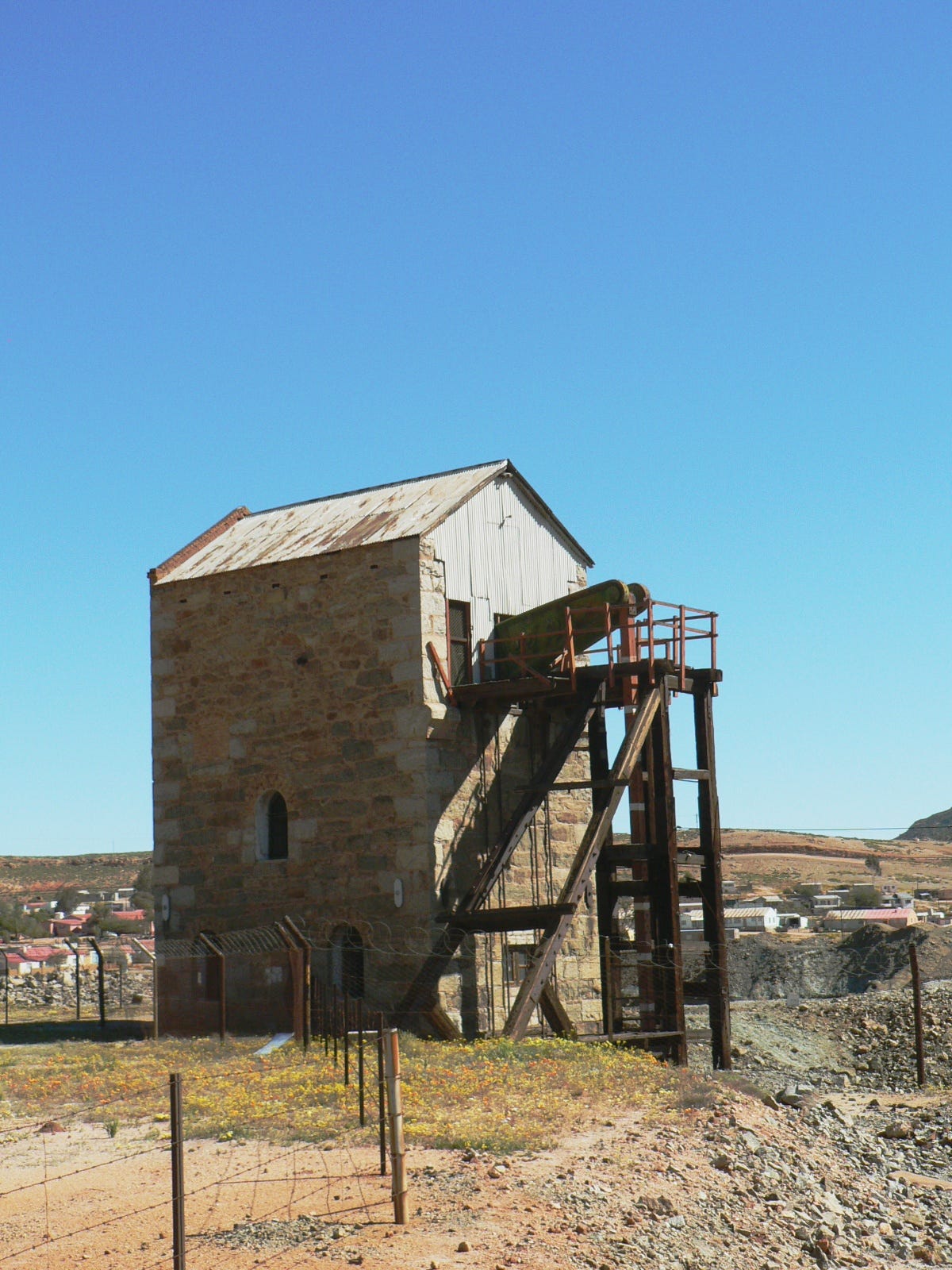
Before South Africa became synonymous with gold and diamonds, its mining story began with copper, and with indigenous knowledge.
In 1681, Nama envoys brought copper ore samples to Cape Town. Their accounts of “copper mountains” in Namaqualand stirred Van der Stel’s ambitious 1685 expedition.
It became an eight-month journey into arid country, guided by unequal barter and coercion. Van der Stel sank test shafts that confirmed rich deposits, then walked away. Without harbours or transport infrastructure, the copper remained stranded for the next 150 years.
Copper finally entered commercial exploitation in 1852, when South Africa’s first mineral export left Hondeklip Bay. This marked the birth of South African colonial mining as an industrial and export enterprise. Fifteen years before Kimberley’s diamonds and thirty-four years before the Witwatersrand’s gold, Springbok established the template in full. Foreign capital mobilisation. Export infrastructure driven across hostile terrain. Boom-bust speculation cycles. Migrant labour. Integration into global commodity markets.
As prospecting pushed toward Okiep, Concordia, and Nababeep, ore grades climbed sharply. The completion of the 150 km Port Nolloth railway in 1876 unlocked what indigenous reports had brought to light two centuries earlier.
To grasp how extraordinary Springbok’s copper was, comparison matters. Michigan’s famed copper fields produced spectacular specimens of 100 percent native metallic copper, yet averaged far lower grades in bulk mining. Chilean copper, dominant in global markets, sometimes ran at up to 25 percent. Globally, most copper ore mined today averages about 0.5 to 2 percent copper, and deposits now considered high‑grade typically fall in the 1 to 2 percent range. Okiep Mine’s sustained shipments at up to 30 percent copper saw it widely described at the time as the ‘richest copper mine in the world’.
The timing was critical. As Cornwall’s mines were exhausted and Chilean output declined through the 1870s, Britain’s Industrial Revolution required new copper sources for telegraph wire, locomotive fireboxes, and the electrical systems of modern industry. Namaqualand’s ultra-high-grade ore arrived precisely as industrial demand began to outpace traditional supply.
Here, memory holds Nama traders whose indigenous knowledge first surfaced the copper and carried it south; the migrant labourers and Nama workers who sank shafts, raised ore and kept Okiep’s workings alive, alongside women who laboured on the dressing floors; and the families, including those from Cornwall, who built fragile lives along a copper belt that briefly became the colony’s economic heartbeat.
The copper mountains were always there. Indigenous knowledge knew them first. Railways, capital, and labour extended them into a world being wired for modernity and scale.
This story is also on LinkedIn, published on 13 Jan 2026.