MiningIsHuman Story 2: Manganese, Gold, Tin, and the Western Cape
A Journey Through the Western Cape — Southern Africa’s First Colonial Mining Landscape

In Story One, we followed the VOC’s search for silver, which found manganese instead, and the colony’s first extraction industry — seabird guano, run from Cape Town, stripped by coerced labour, governed by a good-news culture that told investors what they wanted to hear. Van der Stel’s silence about the silver that was never there fed opportunists and schemers for two centuries. The manganese that actually existed in the Cape mountains frustrated every attempt to move it at commercial scale. The gold discovery on the Witwatersrand in 1886 changed what was possible — and gave the Western Cape, one last time, reason to believe it might be in competition.
What the manganese could not become
The manganese that misled Van der Stel’s engineers at Silvermine was real ore. Not silver — but real, and much more widespread across these mountains than the VOC ever understood. Walk the contour paths above Hout Bay, traverse Kasteelpoort or Skeleton Gorge on Table Mountain, hike around Kogel Bay or toward Rooiels — you are walking over manganese. It surfaces at Kommetjie, around False Bay, and further inland at Du Toitskloof. Local people knew of exploitable deposits from the late 1670s. The ore was never a secret. The problem was always what could be done with it.
For two centuries, the answer was nothing. Manganese had limited industrial applications — small-scale use in glassmaking, and some applications in chlorine production. It was not a commodity sought after in the markets. Then, in 1882, the British metallurgist Robert Hadfield discovered that an iron-manganese alloy possessed exceptional toughness and abrasion resistance — manganese steel. The material transformed railway tracks, mining equipment, and structural engineering across the industrialising world. Suddenly, deposits that had been geological curiosities had markets. The Western Cape mountains had more manganese than almost anywhere in the Colony. What they lacked was a way to get it out.
Two operations, separated by the same mountain range, tried to answer that question in the same era. The results were instructive.
In the early 1870s, a substantial deposit was found in Du Toit’s Kloof, above the confluence of the Molenaars River and Du Toit’s Kloof Stream. By the mid-1870s, a genuine mining operation was underway. Workers sorted ore by hand at the adit, pulling out the densest and darkest pieces, dumping lower-grade waste at the entrance. The grade was real. The problem was everything else. The nearest railhead was at Wellington, on the far side of the mountains. No road existed through the kloof — the pass that drivers use today was built by Italian prisoners of war during the Second World War and opened in 1948. Between the mine and Wellington lay steep, remote terrain with no route adequate for ore wagons.
The solution attempted was an aerial cableway — ore carried in buckets over the neck of the pass and down the other side to the railhead. Peter Spargo, the leading historian of these mines, describes the construction as one of the genuinely great South African engineering achievements of the nineteenth century, one that was completely unacknowledged then and since. No photograph of it survives. The steel cables, support towers, and haulage machinery had to be hauled into the mountains without a road. The pylon bases are still there, in the pine trees above the old tunnel, visible to those who know where to look. The mine closed in the late 1870s — most likely for economic reasons, possibly starved of capital before the cableway could prove itself. The ore remained.
The Hout Bay operation came later and tried a different answer to the same problem. Manganese was formally recorded above the town in November 1873, but the deposit attracted no serious attempt until 1909, when a small company began shipping ore to Belgium. In 1910, Hout Bay Manganese Ltd. took over and built something ambitious: thirteen adits and shafts, a 700-metre steel chute dropping ore down the cliff face to near sea level, a crane loading cocopans onto a rail spur to a jetty, then barges to ships offshore. Engineers had solved what Du Toitskloof could not — how to move bulk ore off a mountain when there is no road. Migrant workers, most of whom were from India and numbered more than 200, worked the rock on a piecework basis from 1910. Their names are not recorded.
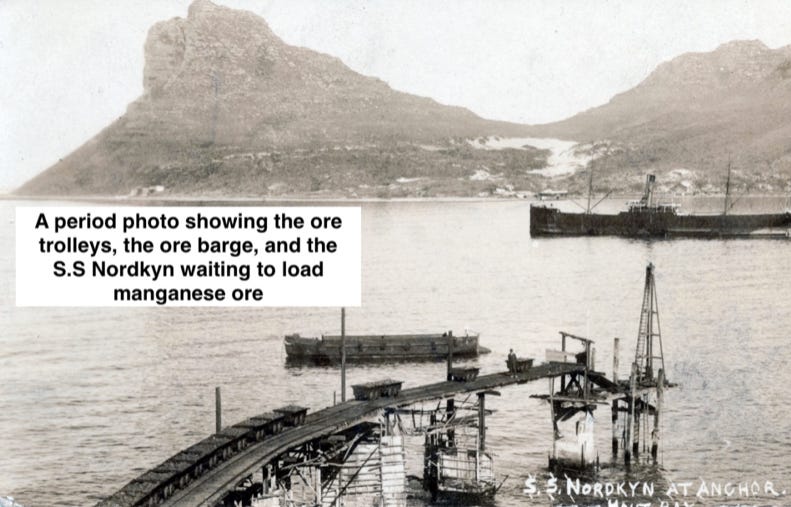
The transport problem was solved. The ore was not. Grade too low, phosphorus too high, the seam narrowing with depth. In 1910, the mine produced around 5,000 tonnes. In 1911, 130. A storm wrecked the barges. By 1912, it was over. An attempt to reopen in 1929 was abandoned within months — overtaken by the Wall Street Crash and, more decisively, by the discovery of the Kalahari manganese field, a deposit so large that it holds approximately 77% of the world’s known manganese resources today. No Cape mountain operation could ever have competed with that.
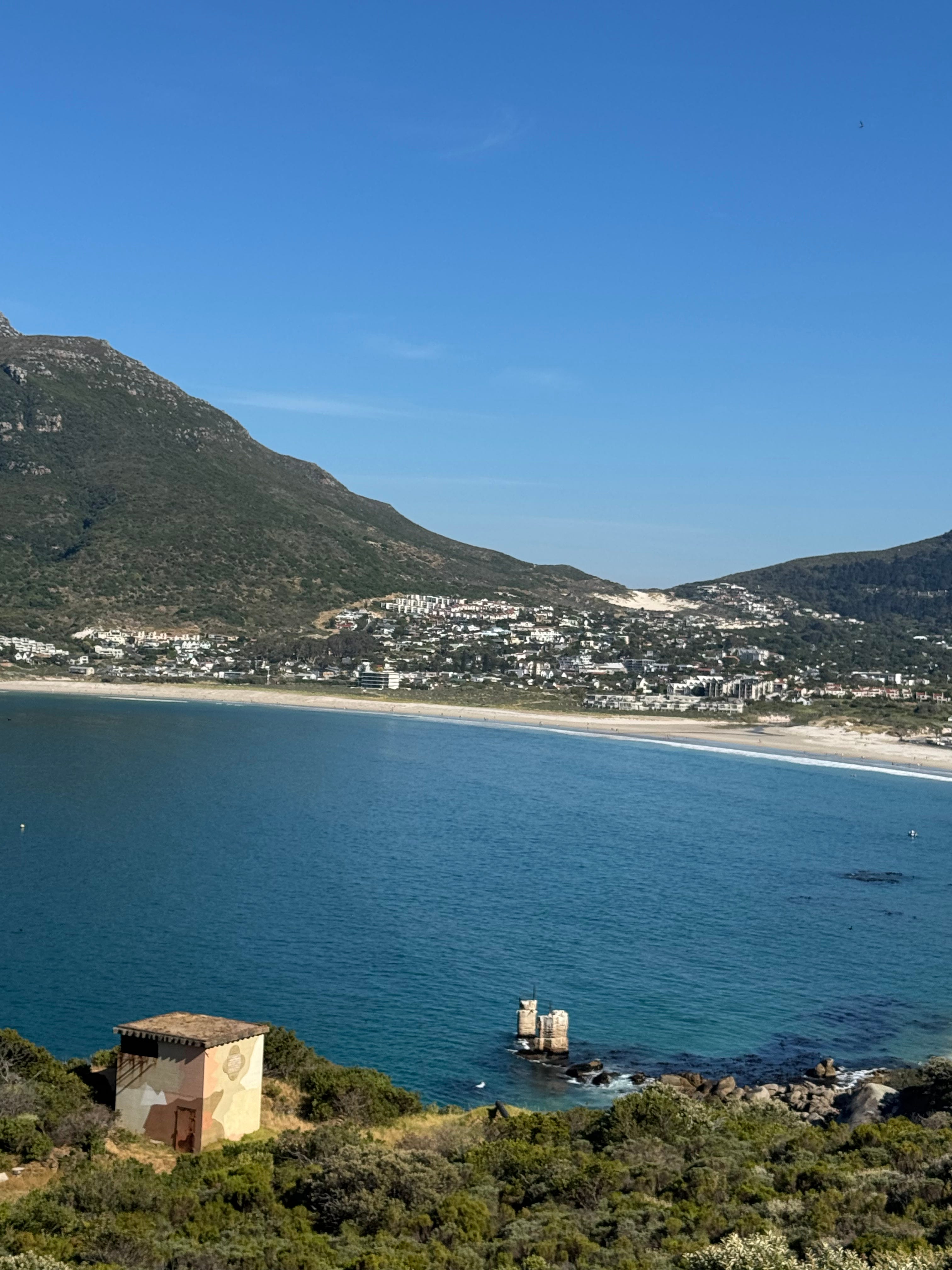
Two pillars of the old Hout Bay jetty are still visible offshore at the start of Chapman’s Peak Drive. The manganese is still in the mountains above them. It always was. It is just not, and was probably never going to be, enough.
And then it was Gold
By the time the Hout Bay mine was being assembled, something larger was already moving through the Colony.
The discovery of the Witwatersrand Main Reef in July 1886 sent a current through every prospector on the subcontinent. It arrived in the context of a decade already intoxicated by mineral possibility — Kimberley’s diamonds had proven that this country held serious ore bodies; now gold was real and close.
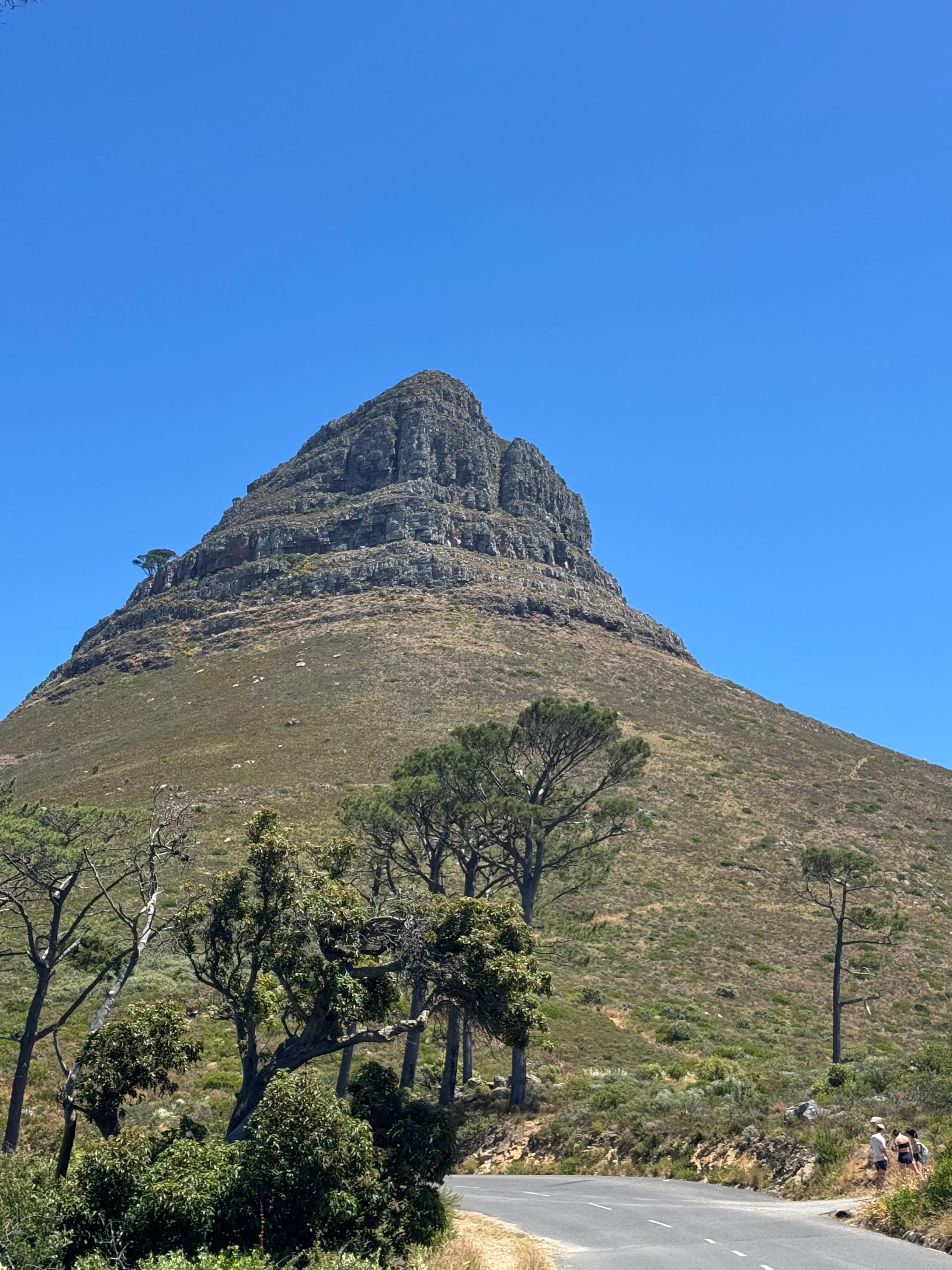
Cape Town briefly imagined it might be in competition. In September 1886, an anonymous letter appeared in the Cape Times announcing that there was “not the least doubt of gold” on the slopes of Lion’s Head. A syndicate was formed. A shaft was sunk on a farm below what is now the hiking trail. Professor P. D. Hahn — the South African College’s chemist — reported 30½ grains of gold extracted from an 80-pound sample. A Cape government official ceremonially sealed several tonnes of ore for overseas assay. Champagne was poured.
What came back was less festive. The ore sent abroad for independent assay returned a negligible result, and a contemporary account reported that there was “not an atom of anything resembling the precious metal in the whole of the quartz.” A satirical column in the Cape Argus drove the point home. Mining ceased in early 1888; the company behind the venture never progressed beyond a failed share offer, and the syndicate finally disposed of its farm in 1892. Whether the early assays were genuine, optimistic error, or something worse remains historically uncertain. Later geological study confirmed gold is present in pyrite-bearing quartz veins on Lion’s Head — real, but at grades too low to mine economically. The distinction between misidentification and manipulation is, in the record, impossible to close. Van der Stel’s ghost had not entirely left the room.
Meanwhile, in the forests above Knysna, the story was more credible. James Hooper, an ostrich farmer, had found an 18 dwt gold nugget at Karatara in 1876 while searching for grit to feed his birds. By 6 January 1887 — days after the Witwatersrand’s first crushing machinery had arrived on the Reef — Millwood was officially proclaimed a goldfield. Fortune-seekers came from California, Australia, and Britain. A village of 135 stands was laid out in a matter of weeks. Thomas Bain, the pass-builder, had assessed the geology and, together with Charles Osborne, a government engineer, jointly compiled an unfavourable report that warned the ground was “unsuitable for a poor man’s diggings.” They were ignored.
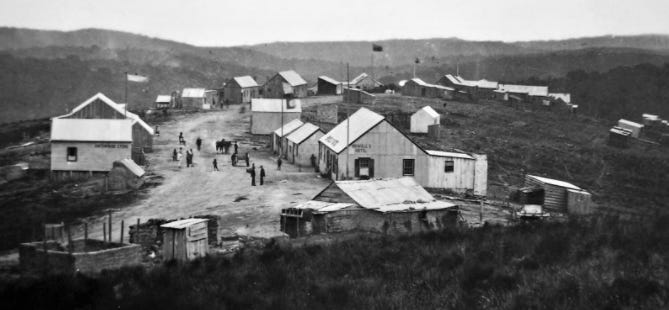
The structural problem was that the gold sat in tightly folded formations that did not persist at depth. Free gold appeared only in oxidised cavities near the surface. Deeper ore locked the metal in sulphide chemistry that the available equipment could not process economically. By 1888, most prospectors had left for the Witwatersrand. Equipment hauled from as far as Australia was left to rot in the forest. The ghost town stands. The Bendigo shaft’s workings still descend.
The Millwood gold was real. The verdict was not geology. It was timing, capital, and the gravitational pull of a richer reef three days’ walk to the north.
The forgotten critical mineral — Tin below the vineyards
In 1910, cassiterite turned up in a stream above Vredehoek, on the lower slopes of Devil’s Peak. The discovery sparked a brief rush of prospecting across the southwestern Cape, as it confirmed what geologists had long suspected: the Cape Granite Suite — the ancient intrusive rock that underlies much of the Peninsula and the Winelands — carries tin wherever it surfaces. It was already known at Durbanville. It was present around Stellenbosch. The Ribbokrant Hills near Kuilsrivier had it in quantity. The question, as always in the Western Cape, was whether it could be moved.
At Vredehoek, the answer came quickly and was mostly no. Mining began in 1911. The Vredehoek Tin Company sank a shaft approximately 55 metres deep and drove an adit approximately 100 to 150 metres into the Malmesbury Group slate. Around a hundred men were employed. The ore was cassiterite at 2.5% tin, real, but erratic, scattered through the rock rather than concentrated in workable seams. The concrete washing flumes were carefully built. The infrastructure was serious. Total production was approximately four tonnes of concentrate. By 1916, it was over.
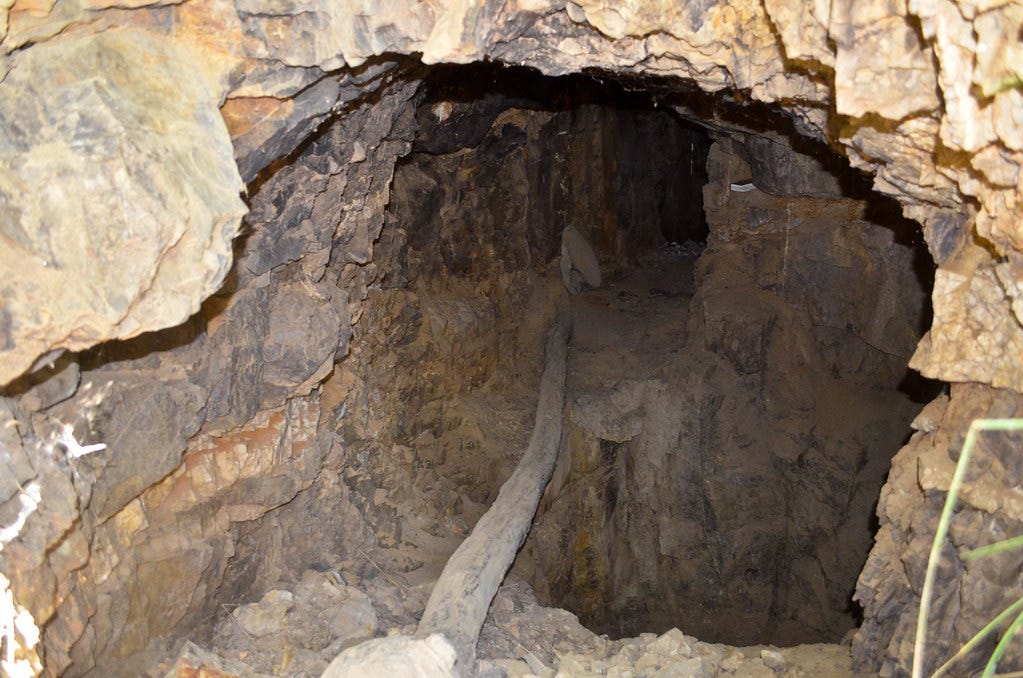
What stopped Vredehoek was not geology but competition. Twelve kilometres away, on the farms Langverwacht and Rosendal on the Ribbokrant Hills near Kuilsrivier, a different and more substantial tin operation was already underway. Cassiterite and wolframite — a tungsten ore — had been found there in 1905, in the gravel beds of the streams running off the granite hills. Those alluvial deposits were the easy pickings: dense cassiterite grains washed down from the primary reefs above, concentrated by the same streams that had been draining the hills for millennia. They were worked first, quickly, and thoroughly. When they were exhausted, the miners turned to the reefs themselves.
The scale of what followed was unlike anything else in the Western Cape’s mineral history. Shafts were sunk into the Ribbokrant Hills — vertical and incline both — to follow the mineralised lodes. The lodes ranged from 1 to 3 metres wide through the granite, carrying cassiterite, wolframite, molybdenite, arsenopyrite, and tourmaline in quartz veins. As the shafts deepened, the operation outgrew hand methods. A large coal-fired boiler and a steam-powered winding engine were imported from Birmingham to lower men and raise ore. The machinery crossed an ocean and came overland to a hillside near Kuilsrivier.
The mine operated for about fifty years. It ran through the First World War, through the Depression, through the Second World War, and into the 1950s. Most of its output came from alluvial gravels, which together produced around 750 tonnes of cassiterite concentrate between 1905 and 1956, compared with roughly 28 tonnes from the lodes. By then, small Western Cape tin operations could no longer compete with the world’s major alluvial producers and ceased operations.
The farms Langverwacht and Rosendal are now the Zevenwacht wine estate. The coal-fired boiler from Birmingham and the old winding engine still sit on the property, open to the sky, unhurried by the vineyards that surround them. The shafts and trenches are still visible on the hills above. The estate’s premium wine range is called Tin Mine — grapes grown exclusively on the slopes that once held the workings, the label the only monument most visitors will ever encounter to the Western Cape’s tin-mining past.
The flumes from the Vredehoek operation survive on Devil’s Peak, above Chelmsford Road, deteriorating. Few people know they are there. The Zevenwacht boiler is harder to miss, but most people who pass it do not know what it is either. The Western Cape’s industrial mineral past has a way of becoming invisible, absorbed into the landscape or repurposed into something more legible. A wine label. A walking trail. Concrete pillars at the waterline. Pylon bases in the pines above a tunnel.
What the mountains remember
The Western Cape tried, across three centuries, to become a mining region. The evidence is not of a landscape barren of minerals — it is of a landscape that kept yielding something real, and a succession of investors who found that real was not enough.
Silver that was manganese. Manganese present everywhere and workable almost nowhere. Gold present but insufficient. Tin genuine but thin — except where it ran for fifty years and still left its boiler standing in a vineyard. Guano that was serious business until it wasn’t.
What runs through every chapter is the same pattern: extraction organised from a distance, on terms set elsewhere, with the knowledge and labour of local people providing the foundation and receiving the smallest share of what was taken. The mountains around Cape Town still carry those traces — the empty shafts, the concrete flumes, the cableway pylon bases buried in the pines above the Huguenot Tunnel, the jetty pillars visible at low tide off Chapman’s Peak.
And underneath all of it, the longer, quieter history of people who knew this landscape long before any of the expeditions departed, and who knew it better than any of them.
The mountains remember differently from archives. They remember silently, and in stone.
Next: the series moves to Namaqualand, where the copper van Werlinckhof assessed in 1685 finally enters industrial production — and where Southern Africa’s first commodity export establishes the template for everything that follows.
Further reading (accessed 14 March 2026)
Manganese in the Western Cape
Manganese — Cape Town’s Hidden Secret — Cape Minerals
https://www.capeminerals.co.za/manganese-cape-towns-hidden-secret
Cape Peninsular: Manganese Hikes and Mines — The Heritage Portal
https://www.theheritageportal.co.za/article/cape-peninsular-manganese-hikes-and-mines
One of the Cape’s Most Remarkable Early Mining Ventures (Du Toitskloof) — The Heritage Portal
https://www.theheritageportal.co.za/article/one-capes-most-remarkable-early-mining-ventures
The Manganese Mines of Hout Bay — Mindat
https://www.mindat.org/loc-56228.html
Hout Bay Manganese Mines — Secret Cape Town
https://secretcapetown.co.za/hout-bay-manganese-mines/
Robert Hadfield and Manganese Steel
Robert Hadfield — Wikipedia
https://en.wikipedia.org/wiki/Robert_Hadfield
Hadfield Manganese Steel — IspatGuru
https://www.ispatguru.com/hadfield-manganese-steel/
Du Toitskloof Pass and Italian POWs
Du Toits Kloof Pass — ExpatCapeTown
https://www.expatcapetown.com/Du-Toits-Kloof.html
Italian Prisoners of War in South Africa — ExpatCapeTown
https://www.expatcapetown.com/italian-prisoners-of-war.html
Kalahari Manganese Field
The Kalahari Manganese Field — Ntsimbi Ntle
https://www.ntsimbintle.co.za/our-business/the-kalahari-manganese-field
The Kalahari Manganese Field — IUGS Geoheritage
https://iugs-geoheritage.org/geoheritage_sites/the-kalahari-manganese-field/
Kalahari Manganese: A Geological Wonder — Minrom
https://minrom.com/kalahari-manganese-field-exploration/
The Kalahari Manganese Fields — Cape Minerals
https://www.capeminerals.co.za/the-kalahari-manganese-fields
Lion’s Head Gold Mine
The Lion’s Head Gold Mine — The Heritage Portal
https://www.theheritageportal.co.za/article/lions-head-gold-mine
Digging Up the Lion’s Head Gold Mine — Cape Town Etc
https://www.capetownetc.com/things-to-do-cape-town/digging-up-the-lions-head-gold-mine/
Cape Town Gold Mining Company, 1887 — Chavonnes Battery
https://www.chavonnesbattery.co.za/blog/post/fools-gold-by-willem-steenkamp/
Did You Hear About the Time Gold Was Mined on Lion’s Head? — SA Promo
https://www.sapromo.com/lifestyle/did-you-hear-about-the-time-gold-was-mined-on-lions-head/
Millwood Goldfield, Knysna
Gold Mining: Knysna’s Millwood Gold Fields — Knysna Museums
https://www.knysnamuseums.co.za/pages/gold-mining/
Knysna Gold: How It All Started — The Heritage Portal
https://www.theheritageportal.co.za/article/knysna-gold-how-it-all-started
Millwood, South Africa — Wikipedia
https://en.wikipedia.org/wiki/Millwood,_South_Africa
Millwood Goldfields — TravelBucket
https://travelbucket.co.za/millwood-goldfields/
Vredehoek Tin Mine
Vredehoek Tin Mine — Mindat
https://www.mindat.org/loc-268646.html
Vredehoek Tin Mine — MCSA Cape Town Section
https://www.mcsacapetown.co.za/2016/11/vredehoek-tin-mine/
Kuilsrivier / Zevenwacht Tin Mine
Zevenwacht Estate — The Tin Mine
https://zevenwacht.co.za/tin-mine/
Wine Estate Celebrates Cape’s Tin Mining Heritage — Engineering News
https://m.engineeringnews.co.za/article/wine-estate-celebrates-capes-tin-mining-heritage-2014-05-23
Kuils River Mineral Locality — Mindat
https://www.mindat.org/loc-56234.html
Kuilsrivier History — Kuilsriver.org.za
https://kuilsriver.org.za/history/