MiningIsHuman Story 1: Silver, Guano, and What the Land Kept
A Journey Through the Western Cape — Southern Africa’s First Colonial Mining Landscape

What the land already had
Mining is ancient here.
Long before ships appeared, the Khoikhoi and San people read this landscape for what it could yield. These groups worked with ochre and iron oxides for ritual and adornment. They carried stone — chert, jasper, silcrete — hundreds of kilometres along trade routes that functioned across generations. They understood which materials held an edge and which crumbled. They returned to the same outcrops across the centuries because they kept yielding. This was not casual. It was inherited place-based knowledge, passed forward in practice.
The presence of manganese-stained rocks — with dendrites, small veins, and localised enrichment along fractures — in the Western Cape mountains was part of that knowledge. Records note that exploitable deposits of manganese were known to local people from the late 1670s. When the Dutch arrived, that knowledge entered their ledgers, as the output of indigenous observation folded into somebody else’s expedition.
The Colonial Demand
By the 1680s, the VOC was in trouble. Its Asian trade empire ran on silver and gold — not as commodities but as currency. To buy spices, silk, or pepper, the VOC needed bullion in enormous quantities. Traditional supply routes were disrupted. Spanish silver went to rivals. After seizing key Portuguese forts on the West African coast, the VOC still lacked a reliable replacement supply.
The instruction sent to Cape of Good Hope Commander Simon van der Stel was blunt: find minerals that could justify the expense of holding this corner of Africa.
He was a company man under pressure that came not from local circumstances but from boardrooms ten thousand kilometres away. Amsterdam needed metal. The VOC Cape needed to deliver it.
The crisis had a specific trigger. In 1685, Japan imposed absolute limits on the value of trade the VOC could conduct at Dejima, ending a supply relationship that had underpinned the VOC’s entire inter-Asian trading network. Without Japanese silver to finance the spice trade, without Spanish supply redirected to European wars, the VOC’s financial architecture was under genuine strain. Van der Stel’s departure from the Castle of Good Hope on 25 August 1685 was not an act of colonial adventurism. It was a response to a global liquidity crisis. The VOC colony was not a backwater of world history in 1685. It was caught in the middle of it.
The expedition that departed the Castle of Good Hope on 25 August 1685 was not a small party. Records state that Van der Stel’s party “included 56 white people, two Macassar prisoners (from Indonesia), three slaves, a carriage with six horses for the governor, eight donkeys, 14 riding horses, two artillery pieces, eight carts, seven wagons (one of which contained a boat) and 289 oxen.” Khoikhoi wagon drivers led the convoy. Interpreters and camp followers joined. Six additional wagons came too, each drawn by eight oxen and belonging to freemen who joined the expedition for the journey as far as the Olifants River. At the Kamiesberg, additional indigenous guides were secured through what the journal delicately describes as a combination of tobacco, liquor, and persuasion. This was a state expedition, launched in force.
The expedition’s most qualified technical presence was Frederick Mathias van Werlinckhof, the VOC’s Mining Overseer. He was travelling through the VOC Cape on his way to command mining operations on the west coast of Sumatra. He was the best assessor the Company had available. He found copper at what is today Springbok. He confirmed what the Nama already knew.
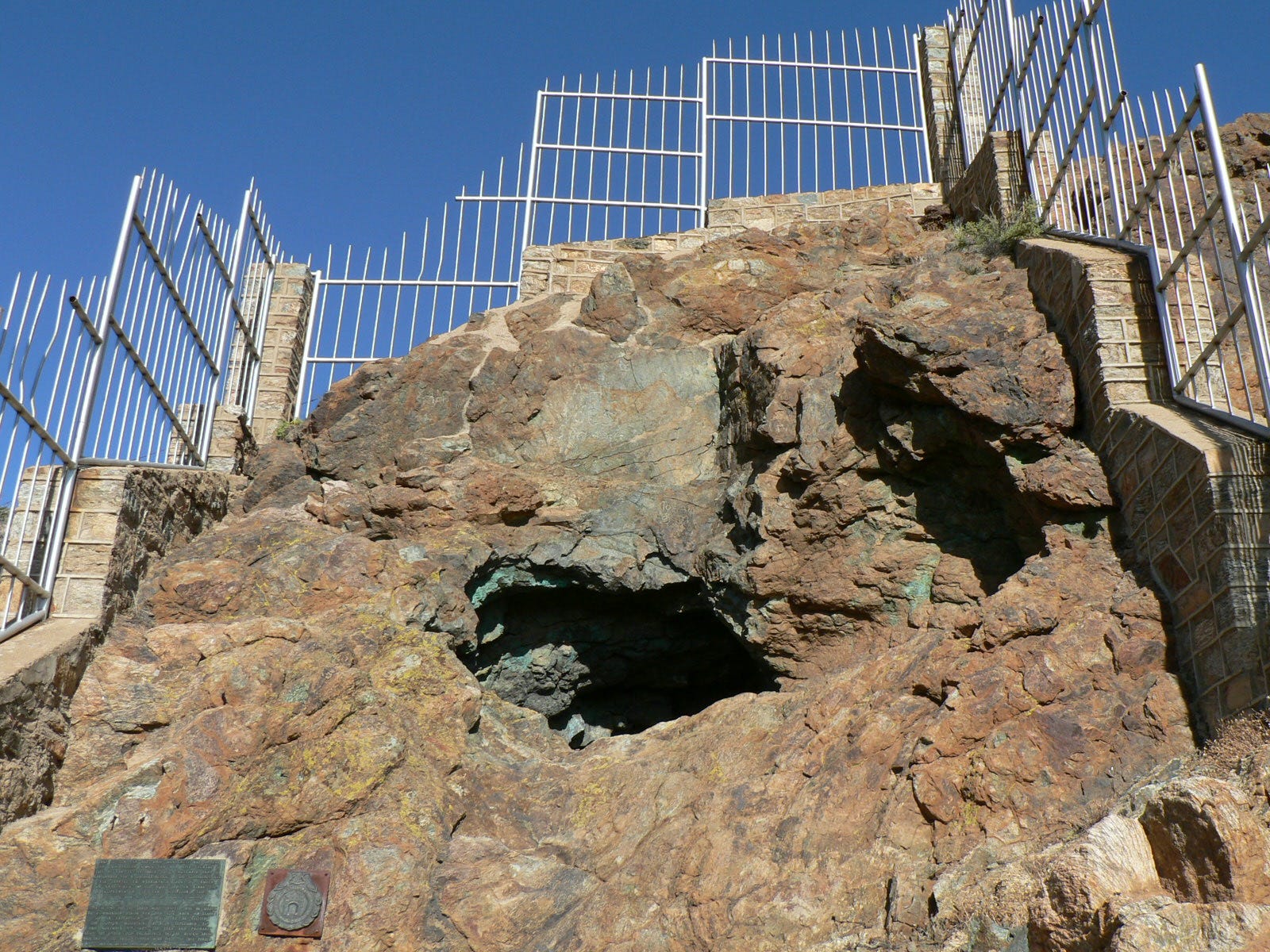
The VOC understood the geology and walked away. Without harbours, roads, or water infrastructure, the copper could not move. It would take nearly 170 years for that ore to reach a market.
What the ancient world did not bequeath to colonial mining was method, ethic, or restraint. The indigenous relationship with mineral resources was one of use, continuity, and accumulated knowledge passed across generations. What arrived with the VOC was something categorically different: extraction in service of a balance sheet ten thousand kilometres away. As will appear later in this story, the first proving ground for that model was not a mine. It was offshore.
But Van der Stel’s expedition turned south. The real target was not copper. It was silver.
What Silvermine Really Was
Three shafts were driven into the mountains at what is now Silvermine Nature Reserve in 1687 and 1688 under Van der Stel’s instructions. The Cape sandstones carried bands of dark, lustrous material. To eyes trained on European silver ores, they had the right look. They were manganese. Not silver-bearing, not remotely similar under proper analysis — but dark and metallic enough in certain light to feed a desperate imagination. The misidentification was probably sincere. Van der Stel was a company man under pressure, in a world mapped with rumours of mineral kingdoms. There was no silver. There never was.
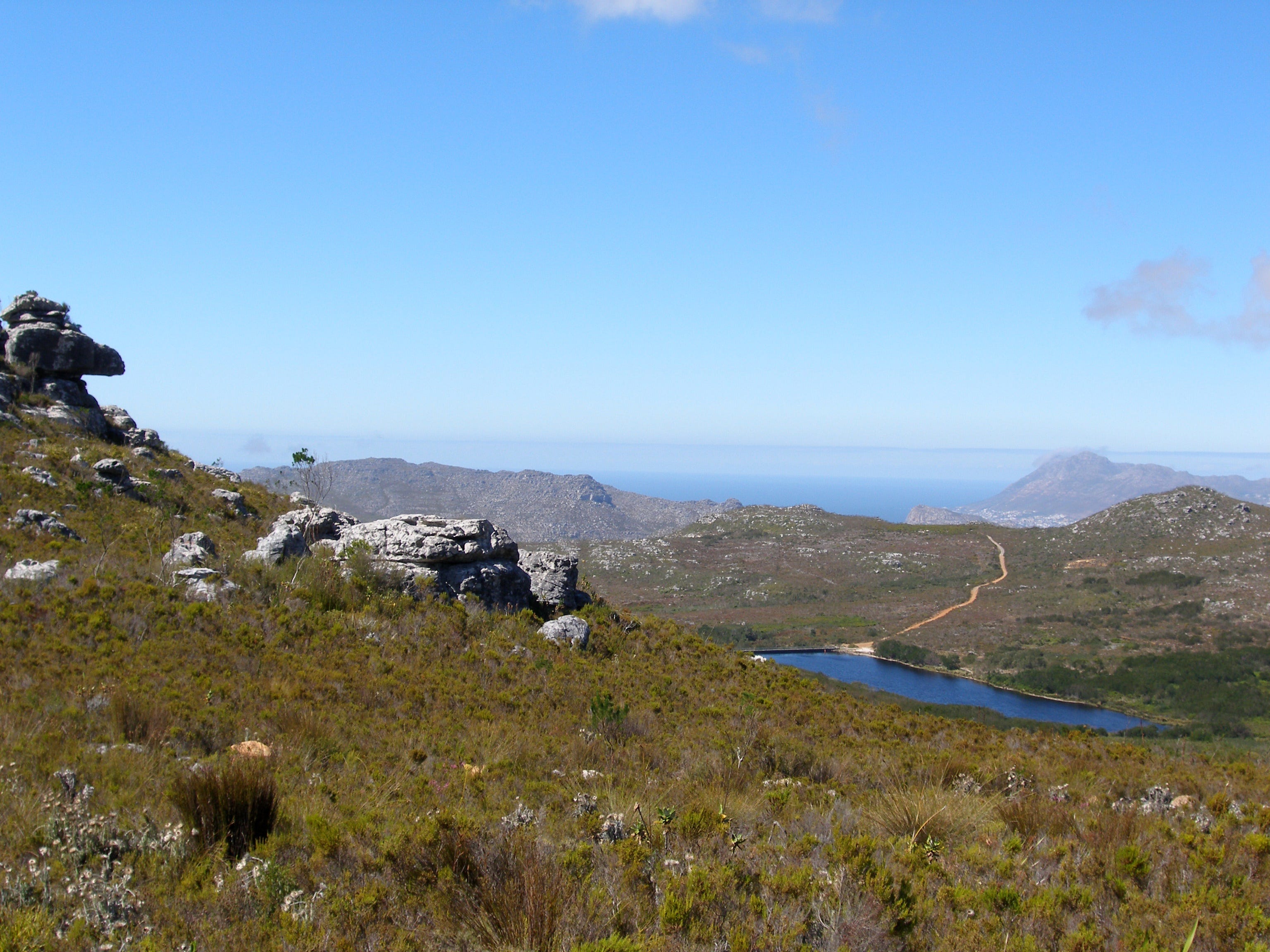
What remains is not much, measured in rock. A shaft 16 metres deep. Two adits driven into the sandstone, one 20 metres, one 15 metres. The Council for Geoscience has noted that they could be preserved as heritage sites. That they have not been is, in itself, a comment on how the Western Cape ranks its colonial mining history. The shafts are small enough to be humbling: a great deal of administrative panic, enslaved labour, and Company ambition, expressed in less than fifty metres of underground excavation.
The men sent to drive those shafts were enslaved or coerced. Today, the empty holes at Silvermine stand as monuments to both anxiety and ambition. But the misidentification had a consequence beyond the shafts. A good-news culture had taken hold: tell the VOC directors what they want to hear, not what the geology says. Amsterdam wanted silver. The VOC colony needed to deliver something. Whether van der Stel ever clearly reported that no silver existed is doubtful. That silence fed generations of opportunists who understood that a credulous appetite, once established, could be sustained indefinitely. Into the nineteenth century, schemes surfaced — each more remote, each more inventive — trading on the same original ambiguity the VOC had created and never resolved. The manganese confusion became the VOC colony’s first mining scam template. It would not be the last.
What the Birds Left Behind
The Western Cape’s first commercial “mined” value did not come from ore; its offshore waters produced the first boom.
The ships left from Table Bay. Licences were issued in Cape Town. Profits flowed back to Cape Town merchants. The regulatory framework — Ordinance 4 of 1845, making seabird guano a Crown resource — was created here. Yet the resource lay hundreds of kilometres away. Ichaboe, off today’s Namibian coast, was the site of the frenzy. Seabird droppings had gathered over metres of barren rock, nourished by colonies feeding on the cold, fish-rich Benguela Current. In 1843, large-scale guano scraping began. Soon, more than 400 ships anchored together. Within two years, Ichaboe was stripped to bare rock.
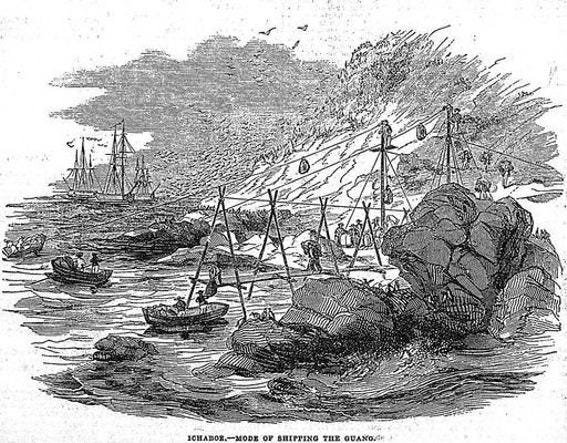
The Cape Colony’s offshore islands — Malgas, Jutten, Vondeling, Bird Island, Dassen Island — were closer to Table Bay. They still required ships, capital, and licences. Academic historians classify what happened to them as mining. The guano was a resource, workers were called labourers in records, and merchant capital was organised from Cape Town. These islands formed part of an extraction geography from the Namibian coast to Algoa Bay. All were under the same Crown ordinance, all audited in Cape Town.
Guano workers lived in conditions that contemporaries compared to those in the slave trade. There were deferred wages and credit systems designed to extend indebtedness. Contracts were enforced rigidly. The workers resisted. Over five decades, guano workers on Cape islands and the Namibian coast pushed back against deferred wages through work stoppages, desertion, and refusal. By 1898, their resistance was so persistent and organised that Cape colonial authorities had to intervene and revise the labour system. This was a rare concession in the Cape’s extractive economy. The workers were underpaid and underdocumented, but not passive.
The pattern
The pattern was already complete before a single ore mine was sunk in the interior. A natural resource, accessed by coerced or constrained labour, the wealth exported or captured by capital, the workers underpaid and undocumented. The Cape Colony had demonstrated, on seabird droppings, every element of the extractive logic that would define its mining economy for the next century and a half.
What the ancient world had practised was nothing like this. Indigenous mining was local and purposeful. It was embedded in a relationship with place that lasted millennia. Colonial extraction was the opposite: organised from afar, by those who never saw the resource. The guano industry taught the Cape Colony — and the investors watching from London and Cape Town — that labour could be coerced. Resources could be stripped. Capital could be removed, all without consequence to those who held the contracts. It would be speculative to draw a direct line from the guano labour regime to what followed at Springbok a decade later. But the record is clear: what separated the guano workers from the enslaved men who had driven van der Stel’s shafts was, historically, a matter of narrow margins. The template was set offshore, on bird droppings, before a single industrial mine was opened on the subcontinent.
The Western Cape ore bodies were real. The scale was always wrong. What changed that calculus — briefly, incompletely — was gold. That is the next story.
Further reading. (Accessed 14 March 2026)
Simon van der Stel’s 1685 Expedition
Diary of a Journey made by Governor Simon van der Stel to the country of the Amaquas, in the year 1685 — Rhodes University, South African Quarterly Journal
https://journal.ru.ac.za/index.php/saqj/article/view/2617
Diary of a Journey (second instalment) — Rhodes University
https://journal.ru.ac.za/index.php/saqj/article/view/2639
The Story of Simon van der Stel — UP Journals, Historia
https://upjournals.up.ac.za/index.php/historia/article/download/2860/2697/11200
The Mining Link Connecting Simon van der Stel to Herbert Hoover — The Heritage Portal
https://www.theheritageportal.co.za/article/mining-link-connecting-simon-van-der-stel-herbert-hoover
Simon van der Stel — South African History Archive
https://sahistory.org.za/people/simon-van-der-stel
National Archives: 1686 Expedition by Simon van der Stel to the Copper Mines
http://www.nationalarchives.gov.za/node/9461534
Frederick Matthias van Werlinckhof
S2A3 Biographical Database of Southern African Science — Werlinckhof entry
http://www.s2a3.org.za/bio/Biograph_final.php?serial=3103
Silvermine and Cape Town Mining History
The Mining History of Cape Town (Paper 58) — American Geosciences, IGC Open Collections
https://information.americangeosciences.org/open-collections/igc/58/
Silvermine Ruins and Mineworks — Stellenbosch Heritage
https://www.stellenboschheritage.co.za/property/silvermine-ruins-mineworks
The Story of Silvermine Valley and Its Farms — The Heritage Portal
https://www.theheritageportal.co.za/notice/story-silvermine-valley-and-its-farms-derek-stuart-findlay
Namaqualand Copper
Aspects of the History of Copper Mining in Namaqualand — UCT Open Access
https://open.uct.ac.za/server/api/core/bitstreams/c8abf1de-11f5-4c22-acba-496a960d8c25/content
1684 — The Copper Mountain of Namaqualand — South Africa Online
https://southafrica.co.za/1684-the-copper-mountain-of-namaqualand.html
1852 — The Rise of the Namaqualand Copper Industry — South Africa Online
https://southafrica.co.za/1852-the-rise-of-the-namaqualand-copper-industry.html
History of Copper in South Africa — TurtleSA
https://www.turtlesa.com/copper.html
VOC, Japan, and the Dejima Silver Crisis
Dejima — Wikipedia
https://en.wikipedia.org/wiki/Dejima
The Dutch East India Company and the Rise of Intra-Asian Commerce — Nippon.com
https://www.nippon.com/en/features/c00105/
Guano Trade, Labour, and the Cape Colony
“Discontented Scoundrels Who Crowd the Mercantile Marine Today” — Historia, SciELO
https://scielo.org.za/scielo.php?script=sci_arttext&pid=S0018-229X2013000100004
Guanopreneurs and the Dynamics of Policymaking in the Cape Colony, 1843–1845 — New Contree
https://newcontree.org.za/index.php/nc/article/view/49
The African Guano Trade — Society for Nautical Research
https://snr.org.uk/african-guano-trade-2/
Ichaboe Island — Wikipedia
https://en.wikipedia.org/wiki/Ichaboe_Island
Atlantic Guano — History
https://atlanticguano.com/index.php/history
Historical Reconstruction of Guano Production on the Namibian Islands, 1843–1895 — UCT Open Access
https://open.uct.ac.za/server/api/core/bitstreams/46a14fc1-6b1e-4397-a87e-6f7816d510a6/content